The official requirements
A French ID card costs nothing and is valid for 10 years. The application asks for one photo, less than 6 months old, meeting the standard published on service-public.fr:
- Size: 35×45 mm, portrait
- Background: uniform, light: pale blue or light grey. White is prohibited
- Face size: 32–36 mm from chin to top of the skull, hair excluded (70–80% of the photo height)
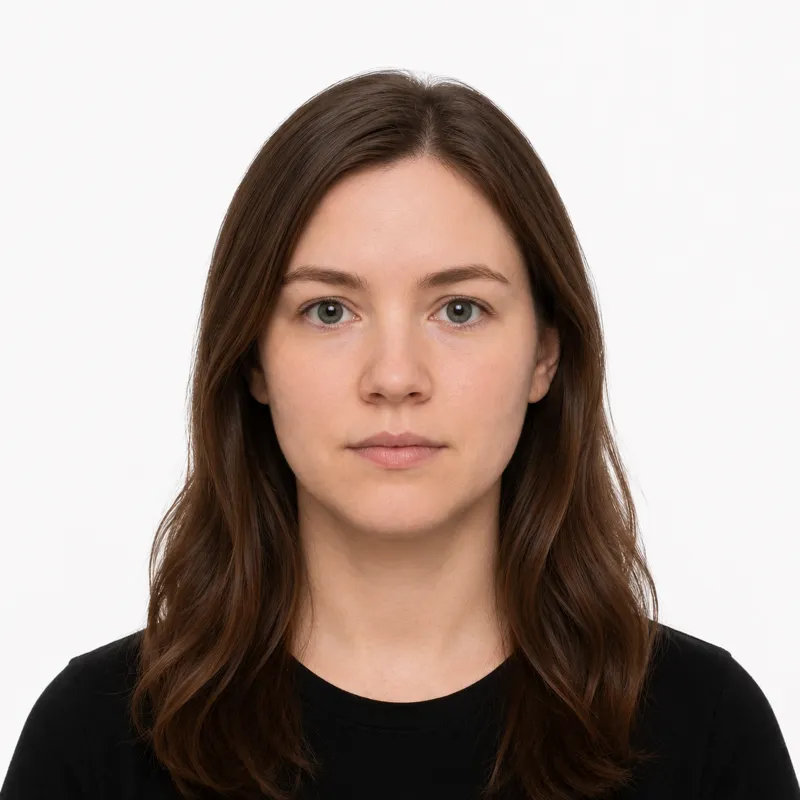
- Expression: neutral, mouth closed, eyes open and fully visible, looking straight at the camera
- Head: bare. No hat, scarf, or headband, and the rules list no religious exception
- Hair: must not cover the face; bangs are accepted if the eyes stay clear; ears must be visible
- Glasses: allowed, but frames must be thin and must not hide the eyes; lenses untinted and free of reflections
- Print quality: sharp, no creases, no marks, no retouching
Two of these trip up more applicants than all the rest combined: the background (white passes in most of Europe, fails in France) and the bare-head rule (France grants no religious exemption, unlike the US or UK).
How to take a compliant photo
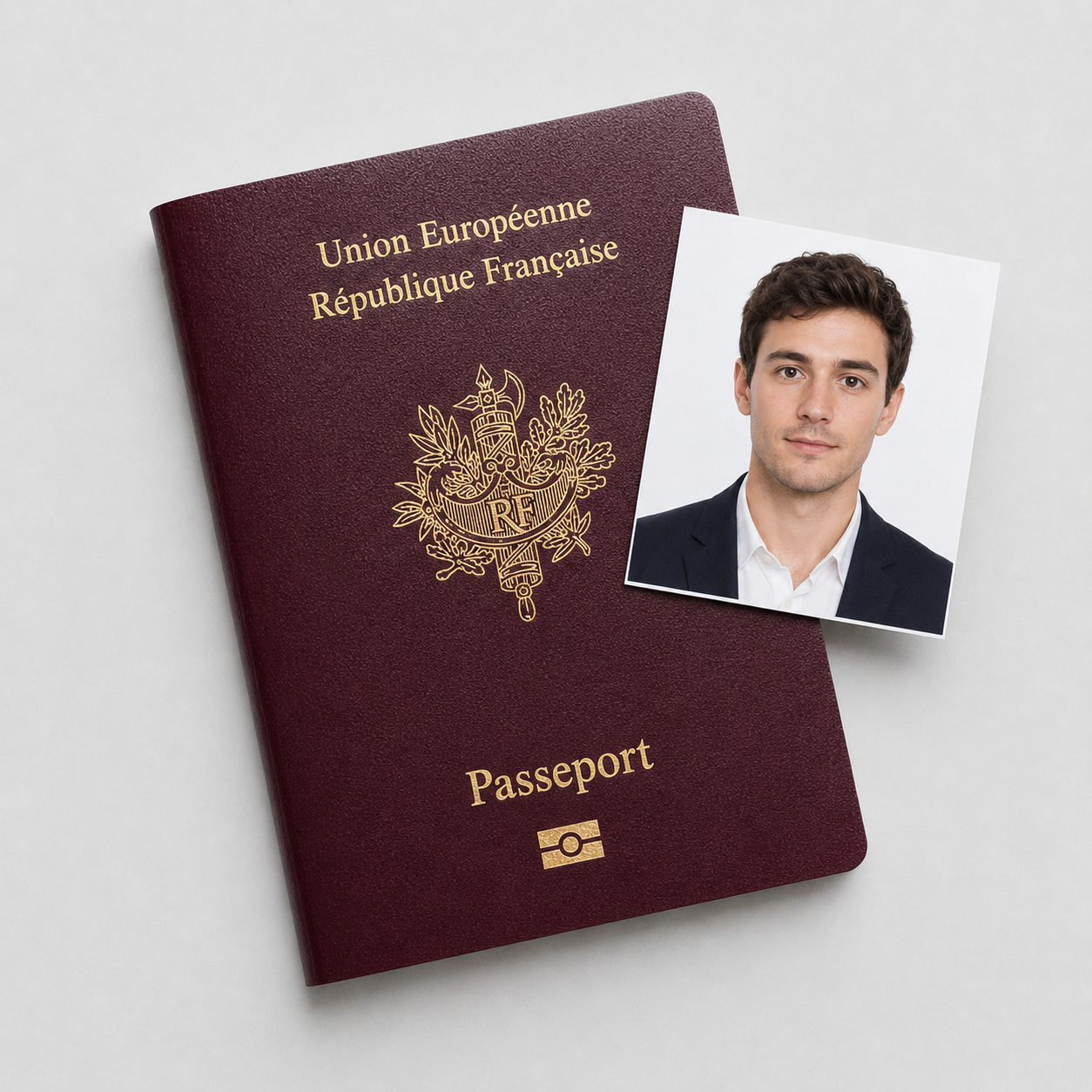
The CNI photo uses the same standard as the French passport photo. If you are renewing both documents (the pre-demande system lets you file them together), one photo session covers everything; you simply need a compliant print for each application.
The shoot itself is simple once the background is solved. Find a plain light-grey or pale-blue surface; a flat-painted hallway wall works, a white wall does not. Stand far enough from it that you cast no shadow on it, and face a window so daylight hits your face evenly from the front. Hand the camera to someone else: a selfie at arm’s length distorts your features and almost never frames the head in the 32–36 mm band.
Before the shot, two French-specific checks that other countries skip:
- Tuck your hair behind your ears. Visible ears are an explicit requirement, and hair covering them is enough for a refusal.
- Take off any headband or hair accessory. The rule says bare head, and “serre-tête” (headband) is named in the official text as an example of what fails.
Then crop to 35×45 mm with the face filling 70–80% of the height, or run the shot through a tool that measures the chin-to-crown ratio against the French spec and flags problems before you print.
Why photos get rejected
The agent at the mairie checks your photo when you hand over the file, so a bad photo costs you the appointment, not just the print. The recurring failures:
- White background. The classic. Re-shoot against grey or pale blue, or replace the background digitally before printing.
- Ears covered by hair. Specific to the French standard and widely missed. Tuck hair back and re-shoot.
- Headband, scarf, or hat. The head must be bare, with no religious exception in the official rules.
- Face outside 32–36 mm. Cropped too tight or too loose. Re-crop rather than re-shoot if the original frame allows it.
- Glare on glasses or thick frames. Tilt the head down a degree or two, or remove the glasses entirely.
- Photo older than 6 months, or one that no longer resembles you.
- Damaged print. Creases, scanner marks, or staple holes on the photo itself.
- Retouching. Skin smoothing and portrait-mode filters count as alteration.
What to wear (and not wear)
Wear a solid mid-tone or dark top. The background is grey or pale blue, so pale grey and light blue clothing melts into it and blurs the outline of your shoulders.
Skip anything on or near your head: hats, headbands, large hoop earrings that touch the jawline, headphones, earbuds. Hearing aids worn daily are fine. Makeup is fine if it does not change how you normally look; the agent compares the photo to the person standing at the counter.
There is no dress code beyond that. Normal clothes, no uniform.
Where to get your photo
France channels ID photos through approved sources, so the practical question is which approved route suits you:
| Option | Price | How fast | What you get |
|---|---|---|---|
| Photomaton booth (agréé ANTS) | €5–€10 | ~5 minutes | Prints + ANTS e-photo code |
| Photographe agréé (studio) | €10–€20 | Same day, sometimes by appointment | Prints + e-photo code, framing done for you |
| Pharmacy or supermarket booth | €5–€10 | ~5 minutes | Prints; e-photo code only if the booth displays the agréé logo |
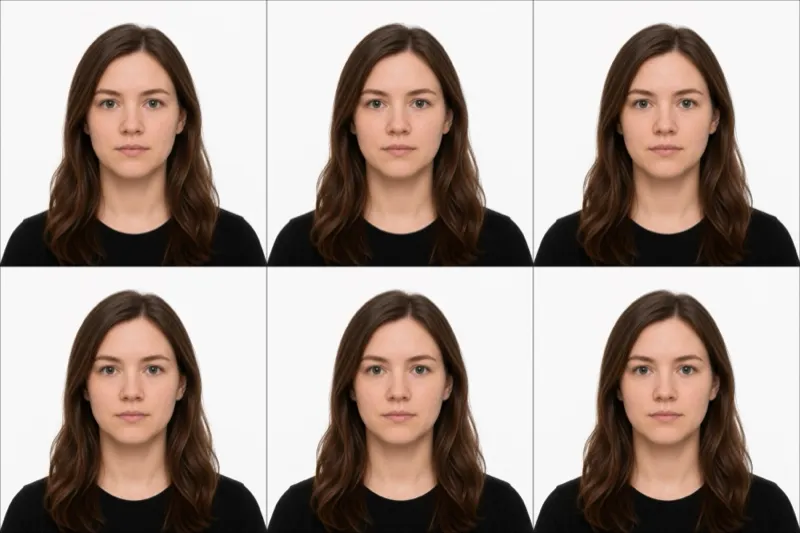
| Online tool (this site) | $1 | ~2 minutes | Compliant digital file + print-ready sheet to print anywhere |
The e-photo code matters if you want the digital photo attached to your pre-demande automatically: only ANTS-approved booths and photographers can issue it. Without a code you bring one printed photo to the appointment instead, which every mairie accepts. A studio is worth the premium if you would rather have a professional own the framing and the background; the booth is the fast cheap default; the online route fits when you want to shoot at home and print for cents at any photo kiosk.
Submitting your photo
The CNI application has one channel: a biometric appointment at a mairie equipped with a recording station (any such mairie, not only your own). The optional online pre-demande on ANTS saves form-filling time but does not replace the visit, since fingerprints are taken at the counter.
At the appointment you supply one photo, either as a print the agent attaches to the file or as an e-photo code entered with your pre-demande. The card itself is free. A renewal after loss or theft is the exception: that costs a €25 timbre fiscal (€12.50 in French Guiana), paid online or at a tabac.
If you are renewing your passport at the same time, the joint application uses the same photo standard, so have a print per document from the same session.
Kids & special situations
Minors. A child’s CNI is requested by a parent, and the child must be present at the appointment. The photo rules are identical to an adult’s: neutral expression, mouth closed, eyes open, bare head, ears visible. For babies who cannot sit, lay them on a plain light-grey or pale-blue cloth and photograph from directly above, with no hands, toys, or pacifier in the frame.
Glasses wearers. The thin-frame allowance exists, but reflections at the moment of the shot are the real risk. If your photo keeps bouncing, take the glasses off; nothing requires you to wear them in the photo.
Medical conditions. If a condition prevents a bare head, a neutral expression, or open eyes, raise it with the mairie before the appointment and bring a doctor’s certificate. Accommodations are handled case by case at the counter.
Ready to skip the studio?
Upload a selfie and get a compliant photo in 2 minutes.
Sources & References
This guide is fact-checked against official government publications and updated regularly to reflect the latest requirements.
- [1] Service-Public.fr — Photo d'identité (official photo standard)service-public.gouv.fr
- [2] Service-Public.fr — Carte nationale d'identité (majeur)service-public.gouv.fr