The official requirements
An infant’s US passport photo uses the same 2×2 inch standard as an adult’s — the State Department does not relax the spec for babies:
- Size: 2×2 inches (51×51 mm), square
- Background: plain white — a white sheet is acceptable
- Head size: 1 to 1⅜ inches (25–35 mm) from chin to crown
- Expression: eyes open and facing the camera — but for babies under 1 year, closed eyes are accepted
- Recency: taken within the last 6 months
- The baby must be alone: no hands, arms, or other people in the frame
The one official allowance is the eyes: an infant under a year old does not need to have their eyes open. Everything else — size, background, the baby alone — is enforced exactly as for an adult.
How to photograph a baby
You cannot pose a baby, so the technique works around that:
- Lay the baby on their back on a plain white sheet. This gives a true white background with no shadow, and the baby can’t tip over.
- Shoot from directly above, camera parallel to the baby’s face, so the face is straight-on.
- Use even, natural light — near a window, no flash, no overhead shadow.
- Make sure no hands or arms are in the shot. If you’re steadying the baby’s head, keep your hands fully out of frame.
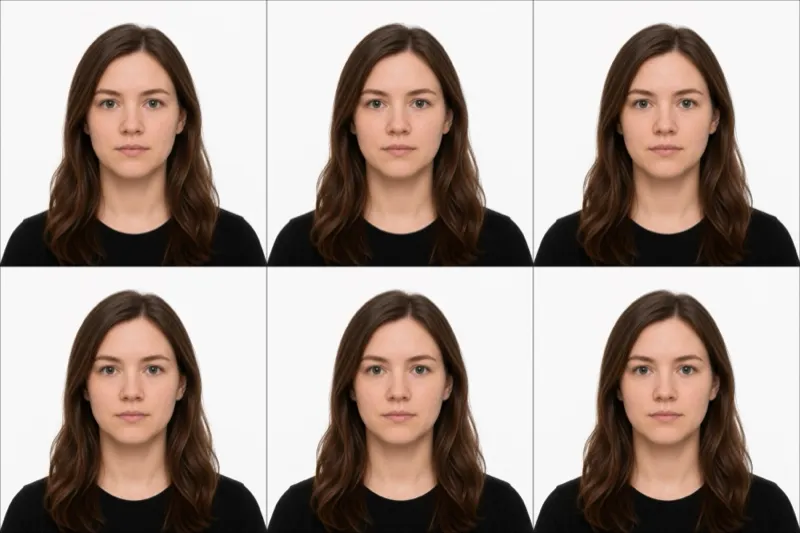
- Take many shots and pick the best — then crop to a 2×2 inch square with the head at the right size. A tool that crops and validates against the spec saves guessing the head measurement.
An alternative for newborns: a white car seat covered with a white sheet, photographed from above.
Why baby photos get rejected
The State Department bounces a predictable set of problems on infant photos. Each one, and the fix:
- An adult visible in the photo — the most common one. A hand steadying the head, or a parent in the background, fails. The baby must be alone.
- Accessories on the baby — no pacifiers, headbands, bows, or hair clips.
- Eyes closed (baby over 1 year) — the under-1 exception does not apply; an older baby needs eyes open.
- Background not white — a patterned sheet or shadowed wall fails. Use a plain white sheet.
- Wrong head size — the head must still be 25–35 mm chin to crown within the 2×2 frame.
- Baby not facing the camera — shoot from straight above so the face is forward-facing.
What the baby should wear
There is no dress code, but a few choices reliably cause trouble.
Avoid: headbands, bows, hair clips, hats, and pacifiers — no accessories at all. Avoid a white onesie, which blends into the white sheet behind.
Fine: plain everyday baby clothing in a solid, darker color. The simplest setup is a plain colored onesie against the white sheet.
Where to get the photo
Photographing a baby is the hard part, and where you do it changes how many tries you get:
| Where | Cost | Retries | Notes |
|---|---|---|---|
| Pharmacy photo counter | ~$15 | Limited — staff time | Staff may struggle to get a still infant |
| At home, then an online tool | $1.00 | Unlimited — your own camera | Shoot dozens of frames, pick the best, crop online |
A baby rarely cooperates on the first frame, so the practical advantage of shooting at home is that you can take as many photos as it takes — then upload the best one to a tool that crops it to 2×2 inches and checks the head size. A pharmacy counter works too, but you’re limited to whatever the staff can capture in a short session.
Submitting the photo
A child’s passport is always a first-time, in-person application — an infant cannot use the online renewal route.
Form DS-11, in person — Both parents (or guardians) appear with the child at an acceptance facility, and you submit one printed 2×2 inch photo on photo paper. Bring the child’s evidence of citizenship and the parents’ ID. Because it must be done in person with the printed photo, prepare the photo before the appointment rather than relying on the counter.
Ready to skip the studio?
Upload a selfie and get a compliant photo in 2 minutes.
Sources & References
This guide is fact-checked against official government publications and updated regularly to reflect the latest requirements.
- [1] US Department of State — Passport Photo Requirementstravel.state.gov