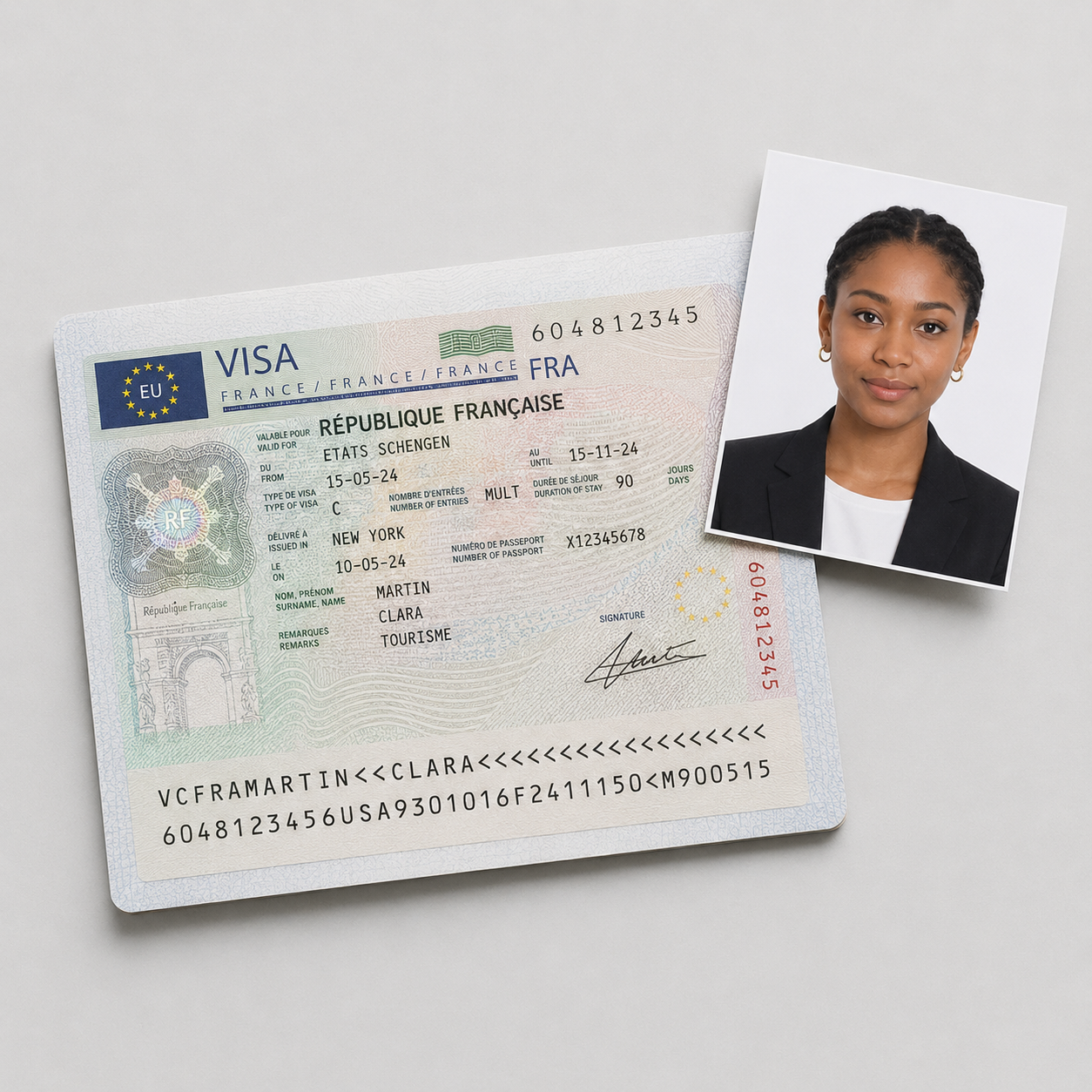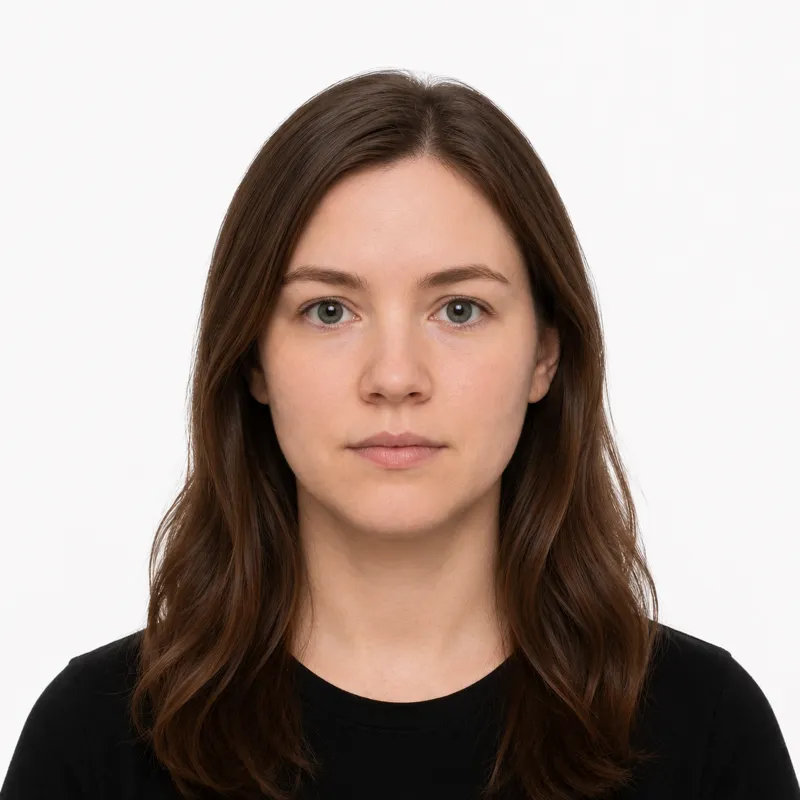
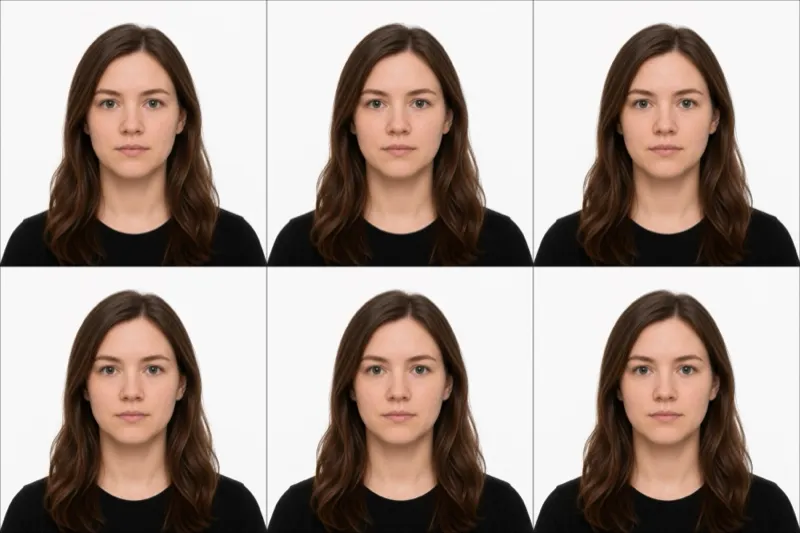
The official requirements
France uses the ICAO 35x45 mm format, but the background rule is the one that catches people: it is not white. The spec set by ANTS (Agence nationale des titres sécurisés):
- Size: 35x45 mm, portrait
- Background: plain light grey or light blue. White is not accepted
- Head size: 32-36 mm from chin to crown (70-80% of the photo height)
- Expression: neutral, mouth closed, both eyes open, looking straight ahead
- Glasses: allowed only with thin frames and clear lenses, no reflections, frames must not cover the eyes
- Head covering: none, except for medical or religious reasons (face fully visible from chin to forehead)
- Recency: taken within the last 6 months
- Color: color photo on quality paper, no filter, no retouching
For a digital photo on an online pre-demande, the file is a JPEG of at least 413x531 pixels and no larger than 240 KB.
Why a white background is rejected in France
This is the rule that bounces more foreign-prepared photos than any other. France requires a light grey or light blue background (the official tint is a neutral gris clair, around #D3D3D3); a plain white background is forbidden, not merely discouraged. It is written into French identity-photo regulation, so a town hall agent or the ANTS portal will reject a white-background photo on sight.
The practical consequences:
- A US or UK photo will not transfer. Those countries require white. The same headshot reprinted on a grey background passes; on white it fails. If you are an expatriate reusing a recent photo, this is almost certainly why it was refused.
- “Off-white” is not grey. A cream or very pale wall reads as an attempt at white and gets rejected. Use a genuinely grey or blue-grey backdrop.
- You can fix it after the shot. If your only wall is white, replacing the background digitally with a light grey (about #D3D3D3) before printing is accepted, provided the rest of the photo is untouched (no retouching of the face).
How to take a compliant photo
The 35x45 mm framing is standard across Europe; the background is where France diverges. The setup that works:
- Stand 1.5-2 metres in front of a plain light grey or light blue wall, never white. A pale, unpatterned wall is ideal.
- Light yourself evenly from the front. Face a window, or use two soft lamps either side. Overhead light drops shadows under the eyes and chin.
- Have someone else shoot it from chest height, straight on. Selfies distort proportions and frame the head wrong.
- Neutral expression, mouth closed, both eyes open, hair clear of the eyes.
- Crop to 35x45 mm with the head at 70-80% of the height, or upload the shot to a tool that crops and validates the head ratio and replaces the background with the correct grey.
Why photos get rejected
French town halls and the ANTS portal bounce a predictable list. Each one and the fix:
- White background. The most common French-specific rejection. Use light grey or light blue, or replace the background.
- Head too small or too large. It must fall in the 32-36 mm chin-to-crown window. Re-crop or re-shoot from a different distance.
- Glasses reflections. Even the permitted thin-frame glasses fail if there is glare on the lenses. Tilt the head down a few degrees, or take them off.
- Thick or tinted frames. Frames that cover any part of the eye fail. Remove them.
- Smile. Even a closed-mouth smile that lifts the cheeks can fail. Stay neutral.
- Shadows on the face or the wall. Step away from the wall and light from the front.
- Filtered or beautified photos. Phone portrait-mode smoothing and any retouching are grounds for rejection.
- Photo older than 6 months. It must reflect your current appearance.
What to wear (and not wear)
Because France shoots against light grey rather than white, the usual advice inverts: here a pale grey top is the one that vanishes into the background. Wear a darker, solid colour to define the head and shoulders.
Avoid: sunglasses, hats and caps, hoods, large jewellery near the face, headphones or earbuds, uniforms, and a light grey or pale top against the grey background.
Fine: ordinary everyday clothing in a contrasting colour, light makeup that keeps your everyday look, hearing aids and other daily medical devices, and religious head coverings worn for religious reasons (the face must stay fully visible from chin to forehead).
Glasses are a grey area: French rules permit them with thin frames and clear lenses, but acceptance hinges on reflections at the moment of the shot. Many photographes agréés now recommend taking them off to remove the risk entirely.
ANTS e-photo code and agréé booths
For a French passport the photo must come from a source the mairie accepts. In practice that is an agréé (approved) Photomaton booth, a photographe agréé, or a digital photo carrying an ANTS e-photo code. Prices and trade-offs:
| Where | Price | Appointment | Speed | ANTS code / digital file |
|---|---|---|---|---|
| Photomaton booth (agréé ANTS) | €5-€10 | No | ~5 minutes | Yes, prints with ANTS e-photo code |
| Photographe agréé (high-street studio) | €10-€20 | Usually | Same day | Yes, prints and digital file |
| Pharmacie with photo booth | €5-€10 | No | ~5 minutes | Only if the booth shows the agréé-ANTS logo |
| Mairie / préfecture photo service | Free-€5 | With application | At appointment | For that application only |
| Our online tool | $1, or $5 with the print sheet | No | ~2 minutes | Digital file (grey background); print sheet in the $5 pack |
Only booths and photographers showing the agréé ANTS logo can issue the e-photo code, the digital reference that lets you finish a passport pre-demande fully online without bringing prints. A purely online tool gives you a compliant grey-background file you can print at any Photomaton or photo lab, but without an e-photo code you will still bring printed photos to the biometric appointment. Whichever route, the photo must meet every rule above.
Submitting at the mairie (pre-demande + appointment)
A French passport application is filed at any mairie with a biometric station, not only the one for your area of residence:
- Online pre-demande. Start on the ANTS portal, pay the timbre fiscal (revenue stamp) online, and book a biometric appointment at a participating mairie. If you have an ANTS e-photo code from an agréé booth or photographer, you enter it here and skip bringing prints.
- Biometric appointment. You appear in person with your supporting documents. Without an e-photo code, you bring one recent printed photo to the spec; the agent attaches it to the file. Fingerprints are taken at the counter. Some mairies can shoot a photo at the appointment, but availability is not guaranteed, so call ahead.
- Renewals and lost/stolen passports. Same channel: pre-demande online, then biometric appointment. The photo rules do not change.
- French nationals abroad apply through their consulate. The 35x45 mm spec and the no-white-background rule are identical; only the appointment channel changes.
Frequently asked questions
Can I use a white-background photo for a French passport? No. France requires light grey or light blue and forbids white. A US- or UK-style white-background photo is rejected. Replace the background with a light grey before printing.
Are glasses allowed? Yes, but only thin frames with clear lenses, no glare, and the frames must not cover the eyes. Because reflections cause most glasses rejections, many approved photographers advise removing them.
What is the ANTS e-photo code and do I need it? It is a digital photo reference issued by agréé booths and photographers that lets you complete the pre-demande online without bringing prints. You do not strictly need it; without one you bring a printed photo to the mairie appointment instead.
Does the mairie take my photo there? Sometimes, but not reliably. Some mairies have an in-house photo service, many do not. Treat the booth or studio photo as the default and call your mairie before relying on an on-site one.
My old French passport photo had a white background and was fine. Why is it rejected now? The light-background rule is enforced strictly through the ANTS portal and biometric stations. A white background that slipped through years ago will not now; produce a grey or blue-grey one.
Ready to skip the studio?
Upload a selfie and get a compliant photo in 2 minutes.
Sources & References
This guide is fact-checked against official government publications and updated regularly to reflect the latest requirements.
- [1] ANTS — Photos d'identité (official passport photo standard)passeport.ants.gouv.fr
- [2] Service-Public.fr — Demande de passeportservice-public.fr