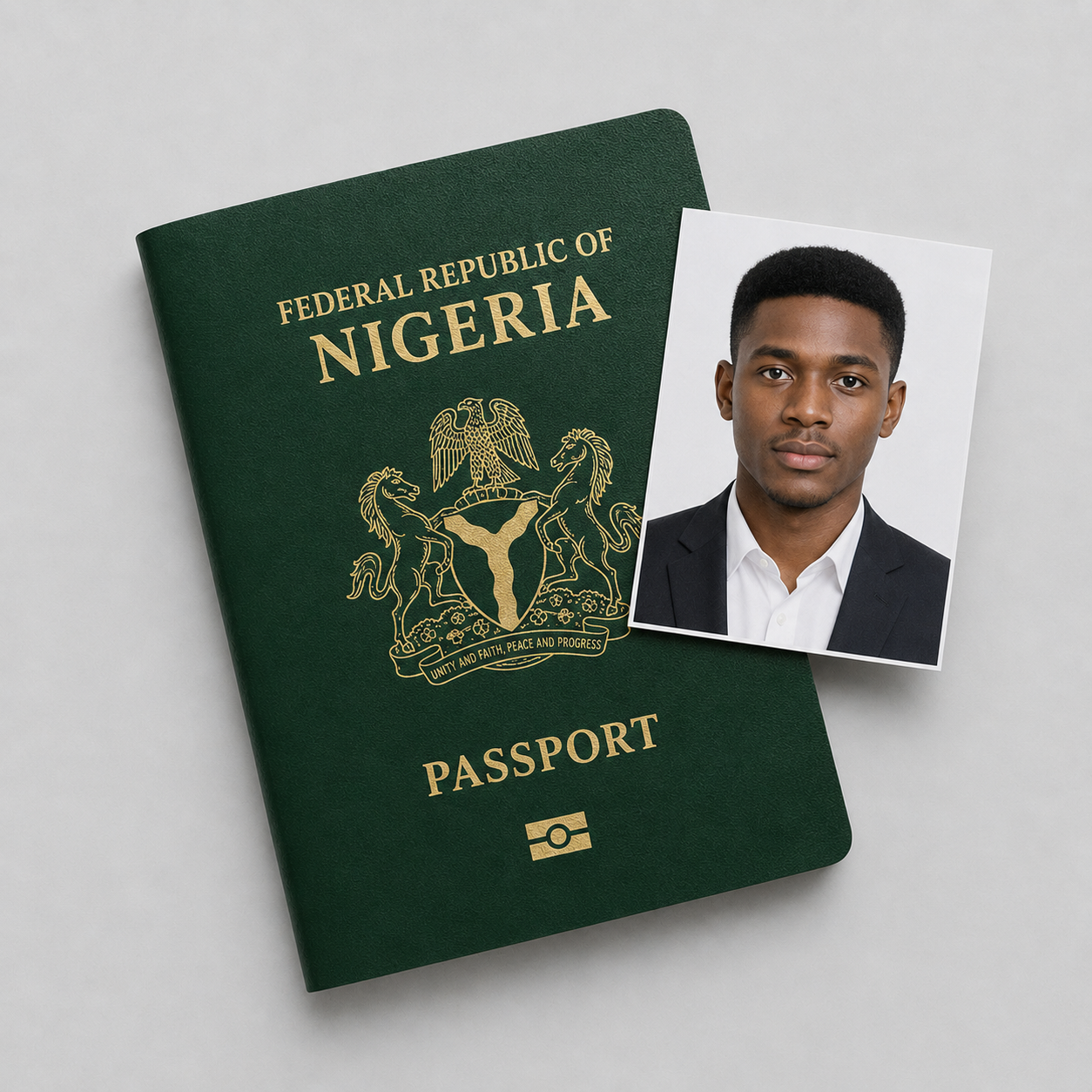
The official requirements
Nigeria uses one photo spec for the visa whether you print it or upload it: 35×45 mm, which the online application takes as a 350×450 pixel JPEG. That single-format rule is unusual (many countries fork the digital spec) and it works in your favour: one correct photo covers the e-Visa upload and any printed copy an embassy route asks for.
The lines that decide acceptance:
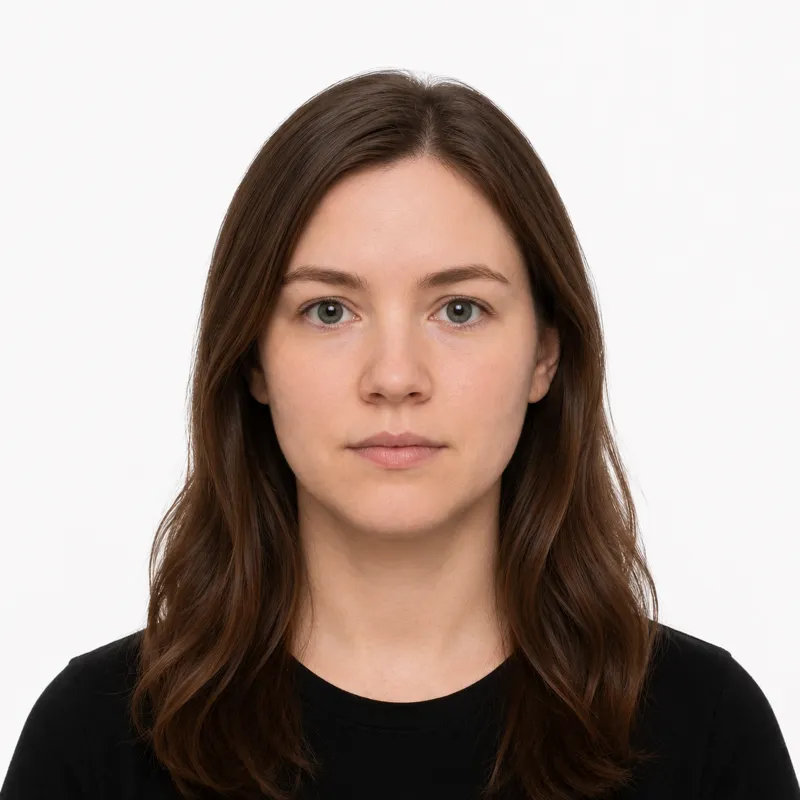
- Background: plain white. Not off-white, not grey, not gradient.
- Head: 31–36 mm tall in the 45 mm frame, with 3–5 mm of space above the hair.
- Expression: neutral, mouth closed, both eyes open, facing the camera straight on.
- Glasses: take them off. Reflections and tinted lenses are treated as an obscured face.
- Head coverings: religious ones only; the face must be fully visible. No uniforms.
- Recency: taken within the last 6 months.
The e-Visa replaced visa on arrival
Since 1 May 2025, Nigeria no longer issues visas on arrival. Every short-stay applicant (tourism, business, family visiting) applies before travelling through the e-Visa portal, uploads their documents including the photograph, and receives the decision by email, typically within about 48 hours.
The practical consequence: the photo stopped being something you could sort out at the airport or the consulate counter. If the upload is wrong, the correction loop happens over email with a flight date approaching. This bites hardest for the largest applicant group at diaspora-heavy consulates: families of Nigerian origin travelling on US, UK, or Canadian passports, who need a visa precisely because they carry a foreign passport. Get the photo right before you open the application form.
350×450 or 200×450? The pixel-size confusion
Search for this document’s photo size and you will find two competing numbers. Several photo-tool sites state the online visa photo as “200×450 pixels”. That figure is wrong, and you can see it from those pages’ own maths: they give the metric equivalent as roughly 14.8×19 mm, which is a 35:45 shape, and then cite 350×450 pixels elsewhere on the same page. The 200×450 number appears to be a misread of a “200 to 450 px” range that has been copied from site to site. We compared six independent spec sources against the NIS image-compliance specification in August 2026; everything consistent points one way: 35×45 mm, uploaded at 350×450 pixels, on white.
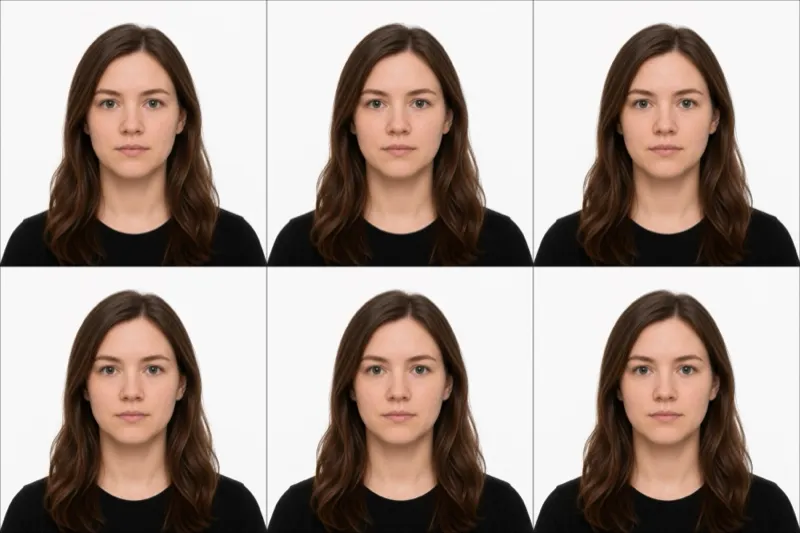
The same check applies to your own file. We ran a test portrait through our cropper against this spec on 8 August 2026: the output came out at exactly the 35:45 ratio with the head at 68% of the frame height, about 30.6 mm at print size, and the eyes 63% up from the bottom edge, inside the compliance bands. A correctly prepared file is not marginal; it sits comfortably inside the tolerances. If your photo is scraping the edge of a band, reframe rather than hope. The photo tool at the top of this page produces the 350×450 file at that framing for $1, with your money back if the photo is rejected.
Why photos get rejected
When the e-Visa review bounces a photo, the correction happens over email against your travel date, so each of these costs days rather than minutes:
- Wrong size or head height. The head must be 31–36 mm of the 45 mm frame. Crop to the exact ratio; do not pad a differently-shaped photo to fit.
- Non-white background. A tinted wall or visible shadow fails. Photograph against true white or replace the background cleanly.
- Glasses left on. Any reflection or tint reads as an obscured face. Remove them for the photo.
- Non-neutral expression. Smiling with teeth, raised eyebrows, or a tilted head all fail. Relax the face and look straight at the lens.
- Hats or headdresses without a religious basis. Remove them; religious coverings must still leave the full face visible.
Frequently asked questions
Is the visa photo the same as the Nigerian passport photo? Same 35×45 mm frame and white background, but the two documents serve different people: the visa is for foreign-passport holders entering Nigeria, the passport for Nigerian citizens. If someone in your family holds a Nigerian passport and someone else needs a visa, one photo session against a white wall can genuinely produce both, cropped to each spec.
What file does the portal want? A 350×450 pixel JPEG in colour. PNG uploads are accepted on some application routes, but JPEG is the safe choice everywhere.
Can I wear my everyday glasses? No. Even ordinary prescription glasses risk reflections, and the compliance check treats anything covering the eyes as a fail. Take them off for the photo.
How recent does the photo need to be? Within 6 months, and it must look like you do now. Reusing the photo from a passport issued years ago is a common quiet failure.
Do children need their own photo? Yes, every applicant on a family trip needs their own compliant photo, including infants. The same spec applies: white background, neutral expression, eyes open.
Ready to skip the studio?
Upload a selfie and get a compliant photo in 2 minutes.
Sources & References
This guide is fact-checked against official government publications and updated regularly to reflect the latest requirements.
- [1] Nigeria Immigration Service — Image compliance specificationpassport.immigration.gov.ng
- [2] Nigeria e-Visa portalevisa.immigration.gov.ng