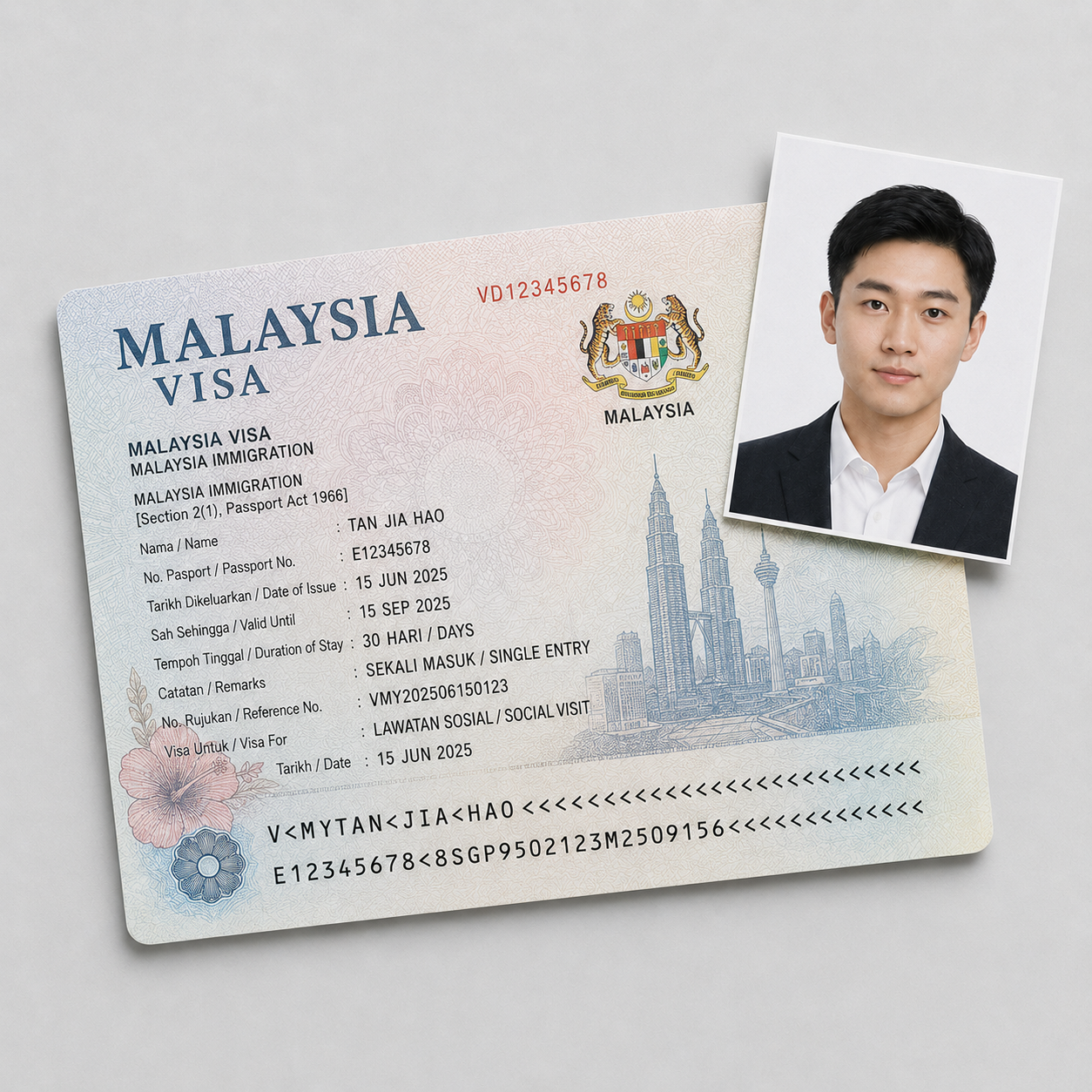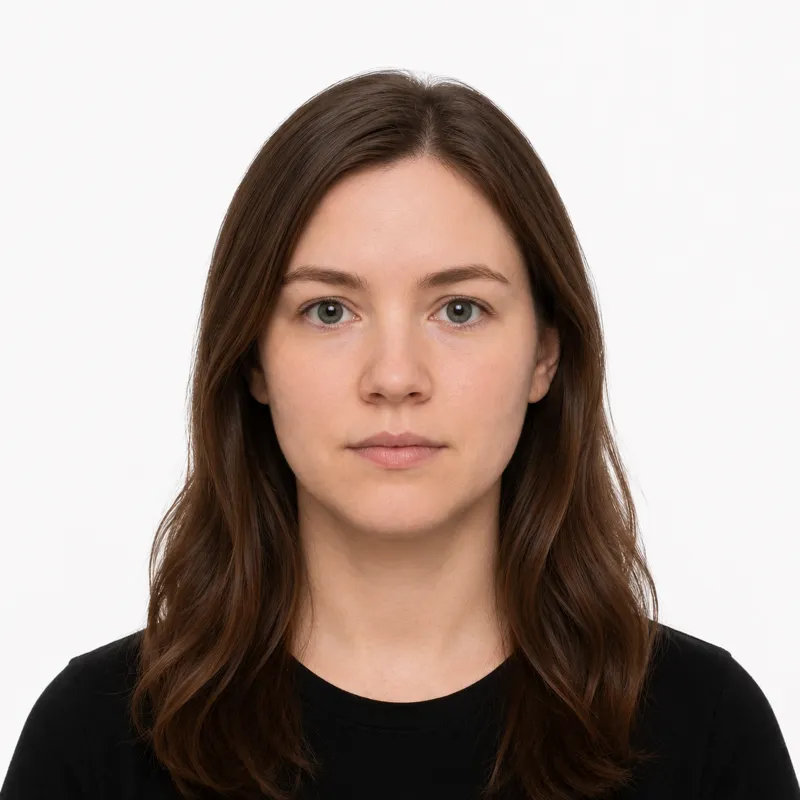
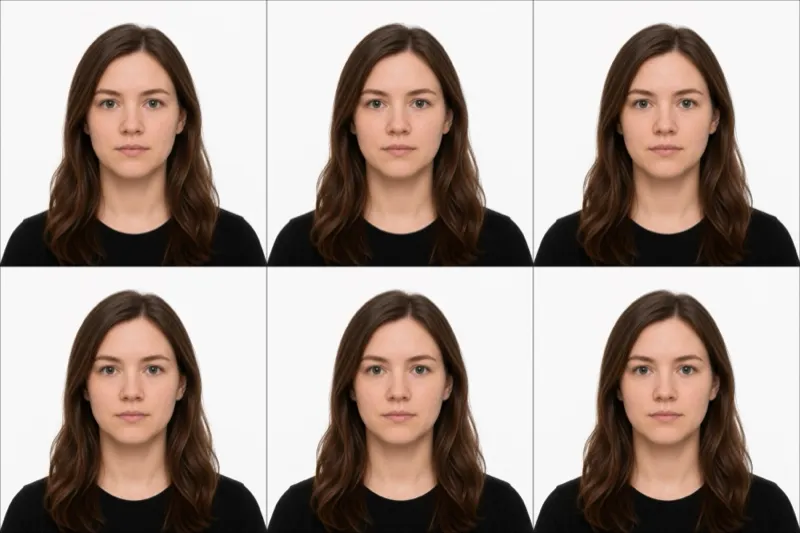
The official requirements
The Malaysian spec is unusually demanding about what stays uncovered: both ears and the full forehead must be visible, which is the rule that trips up applicants in a fringe or a low tudung. The full list:
- Size: 35×50 mm (3.5×5 cm)
- Background: plain white, no shadows, no patterns
- Head size: 25–30 mm from chin to crown (about 50–60% of photo height)
- Expression: neutral, mouth closed, both eyes fully open and clearly visible
- Ears: both ears must be visible — hair or accessories cannot cover them
- Forehead: fully visible, not covered by hair or a head covering
- Glasses: not allowed — including prescription glasses
- Recency: taken within the last 6 months
- Color: color photo with even lighting, no filters
For digital submission through MyOnline Passport, the file is a JPEG, 413×591 pixels, between 100 KB and 1 MB. Anything outside that range is rejected by the portal at upload.
How to take a compliant photo
A recent phone camera is fine — Malaysian passport photos fail on background, head size and ears far more often than on camera quality. The setup that works:
- Stand 1.5–2 m in front of a plain white wall, with enough distance behind you that you don’t cast a shadow on the wall.
- Face a window so daylight hits you evenly from the front. Overhead ceiling lights cast shadows under the eyes and chin — avoid them.
- Have someone else take the photo at eye level. A selfie distorts facial proportions and almost always frames the head wrong.
- Pull hair back behind your ears, clear the forehead, look straight at the lens, neutral expression.
- Crop to 35×50 mm with your head occupying roughly the middle 55% of the frame — or upload the shot to a tool that crops and validates against JIM’s spec for you.
Why photos get rejected
Counter staff at JIM and the MyOnline Passport check bounce the same handful of issues again and again. Each, with the fix:
- Glasses on — the most common rejection. Take them off, prescription included.
- Ears hidden — hair, hijab, or earrings covering one or both ears. Tuck hair behind the ears; pin the tudung back.
- Forehead covered — fringe or a low headscarf hiding the hairline. The forehead must be fully visible.
- Head wrong size — chin to crown must be 25–30 mm. Re-shoot closer or further, or re-crop.
- Shadows on the face or wall — usually caused by overhead light or standing too close to the wall. Move away from the wall, light from the front.
- Background not truly white — a cream or grey wall reads as off-spec under the JIM scanner.
- Smile or teeth showing — keep the mouth closed.
- File too small or too large — for digital submission, the JPEG must be 100 KB–1 MB.
What to wear (and not wear)
The tudung is where most clothing rejections happen: keep it on if you wear one daily, but it has to be a dark colour and must leave the forehead, ears, and chin fully clear, since a light hijab simply vanishes into the white background. Beyond that:
Avoid: glasses of any kind, caps or hats (other than a religious head covering, see below), white or very light tops that blend into the white background, uniforms, and visible camera-strap branding. School uniforms in particular are commonly refused for adult passports.
Wear: plain, darker, solid-colour clothing that contrasts with the white background — a navy, dark grey, brown or black top is the safest choice. Light makeup that doesn’t change your everyday appearance is fine. Hearing aids and other medical devices worn daily are allowed.
If you wear a tudung or other religious head covering daily, you may keep it on — but it must be a dark colour and must not cover the forehead, ears or chin. The full face from forehead to chin needs to be visible.
Where to get your photo
You can get a Malaysian passport photo at a pharmacy chain, a mall photo studio, or online. Prices and trade-offs in Malaysia:
| Where | Price (MYR) | Appointment | Speed | Digital file | Acceptance |
|---|---|---|---|---|---|
| Watsons photo counter | ~RM 15–25 | No | Same day | Sometimes, on request | Counter-checked |
| Guardian photo service | ~RM 15–25 | No | Same day | Sometimes, on request | Counter-checked |
| Photobook Malaysia (online order) | ~RM 10–20 + delivery | No | 2–5 days | Yes | Depends on shoot |
| Mall photo studio (e.g. Mid Valley, Sunway, KLCC) | ~RM 20–40 | No | Same day | Yes | Studio-checked |
| Kedai gambar (neighbourhood photo shop) | ~RM 10–20 | No | Same day | On request | Varies |
| Online tool (this site) | ~RM 5 (US$1) | No | ~2 minutes | Yes | Money-back if rejected |
In-store is the path most Malaysians know — the shop sits you against a white backdrop, prints the photos, and hands you four prints in a paper sleeve. The trade-off is that many neighbourhood shops do not give you a digital file by default, which you need for MyOnline Passport. If you book online for renewal, ask the shop explicitly for the JPEG. Online tools are cheaper and give you both the print sheet and the digital file ready for upload.
Submitting your photo
Malaysia gives you three routes: the MyOnline Passport portal for renewals, a JIM office counter that shoots the photo for you, and overseas high commissions that want printed copies with the form.
MyOnline Passport (online renewal) — Renewing through the JIM portal, you upload a JPEG (413×591 px, 100 KB–1 MB) when you reach the photo step. The portal validates the file; a wrong size, glasses, or off-white background gets rejected at upload and you re-submit.
In person at a JIM office (UTC, Pusat Imigresen, or Putrajaya HQ) — For first-time passports, kids’ passports, or applicants who don’t qualify for online renewal, JIM offices will capture a fresh biometric photo at the counter as part of the application. You don’t strictly need to bring printed photos, but bringing a compliant 35×50 mm print is useful as backup and is required by some overseas missions and consular posts.
If you’re applying through a Malaysian high commission or embassy overseas, check that post’s local instructions — some require two printed 35×50 mm photos submitted with the form, on photo paper, with your name on the back.
Tudung, kids and special situations
Tudung and other religious head coverings are permitted if worn daily for religious reasons. The covering must be dark coloured and must not cover the forehead, ears, or chin — the full face must be visible. A light-coloured hijab blends into the white background and gets rejected.
Infants and children follow the same rules as adults — no pacifiers, no toys, no hands or arms in the frame, both eyes open, mouth closed. For very young babies, lay the child on a plain white sheet and shoot straight down. Eyes must be open and looking at the lens.
Glasses are not permitted, even prescription. Take them off for the photo; the JIM scanner flags glare and partially obscured eyes immediately.
Medical exceptions — hearing aids, oxygen tubes, and other devices worn daily are fine. For a covered eye or other temporary medical situation, bring a doctor’s letter when you submit.
Ready to skip the studio?
Upload a selfie and get a compliant photo in 2 minutes.
Sources & References
This guide is fact-checked against official government publications and updated regularly to reflect the latest requirements.
- [1]