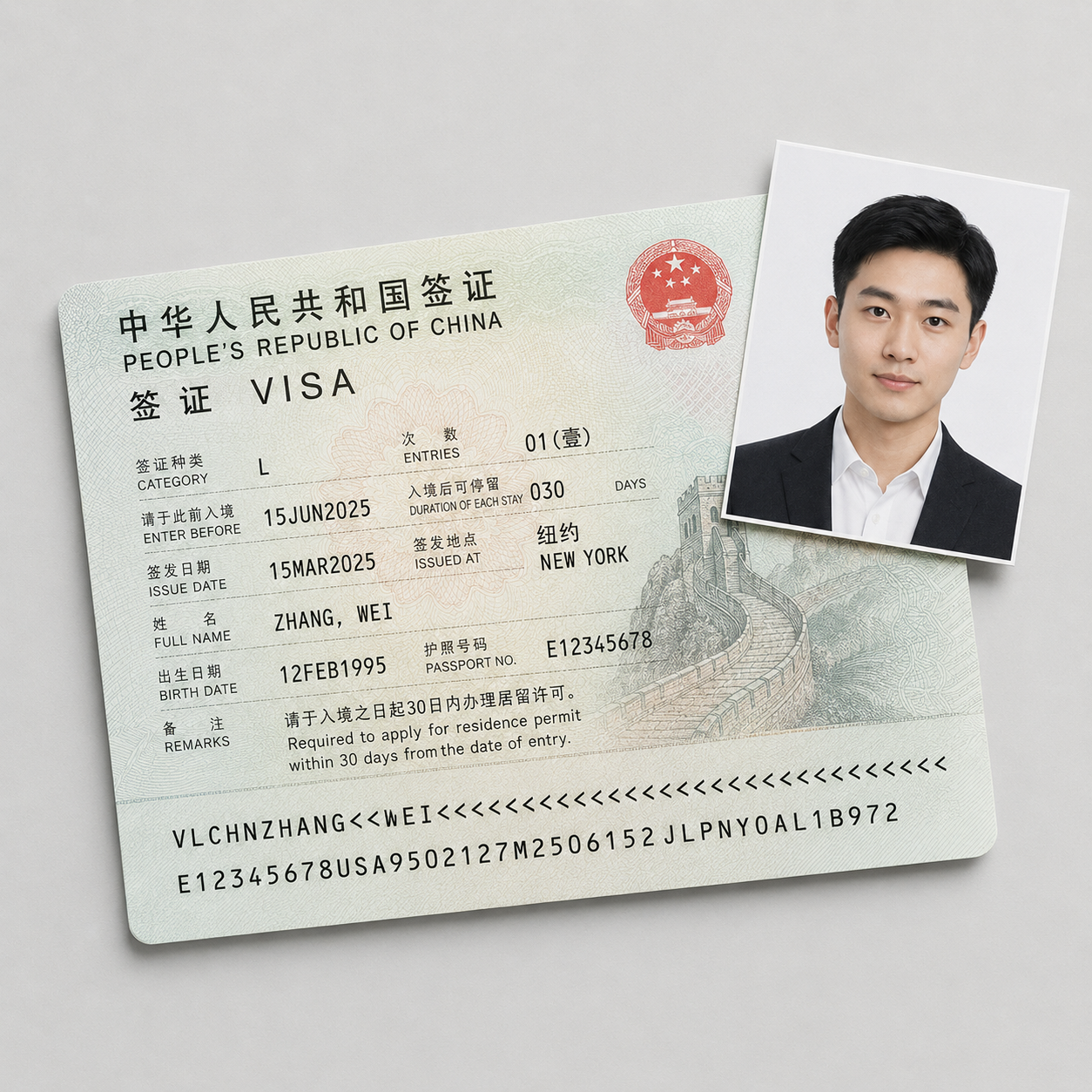
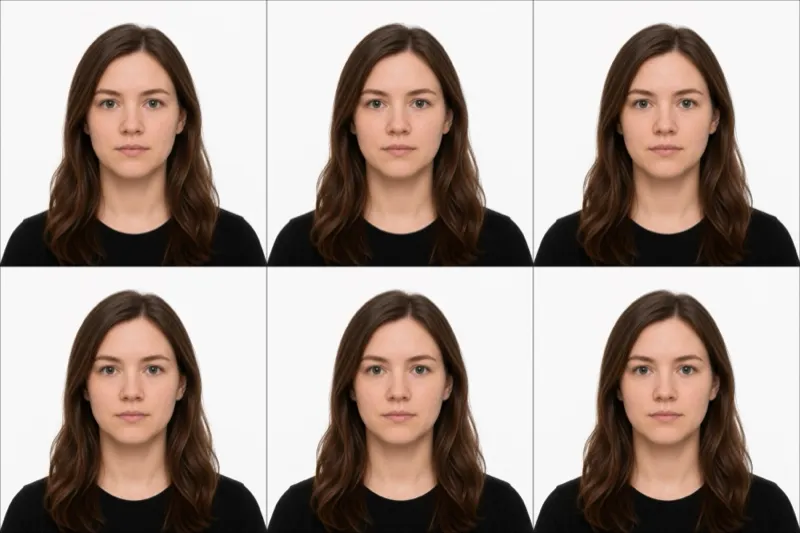
The official requirements
China’s passport photo uses a size unique to China — no other country shares it. The spec:
- Size: 33×48 mm, portrait — not the 35×45 mm ICAO format
- Background: plain white
- Head size: 28–33 mm from chin to crown
- Expression: neutral, both eyes open, head straight and facing the camera
- Ears: both ears must be clearly visible
- Glasses: allowed, but removing them is recommended — glare and heavy frames are common rejection causes
- Recency: taken within the last 6 months
- Color: color photo only
For a digital file, use a JPEG, 390×567 pixels, on a plain white background, no larger than 2 MB. Printed photos should be on glossy photo paper.
How to take a compliant photo
The 33×48 mm size matches no other standard, so a leftover ICAO or US photo will not fit. The setup that works:
- Stand 4–6 feet from a plain white wall, far enough that no shadow falls behind you.
- Light yourself evenly from the front — face a window.
- Tuck hair behind both ears and pull it back from the face so both ears show.
- Have someone else take it from chest height, straight on. A selfie distorts the face.
- Look directly at the camera, neutral expression, head straight, both eyes open.
- Crop to the China-specific 33×48 mm size — or upload the shot to a tool that crops to that exact size, not the ICAO format.
Why photos get rejected
The same problems get photos bounced repeatedly. Each one, and the fix:
- Wrong size — anything other than 33×48 mm. An ICAO or US photo will not fit. Crop to the China size.
- Background not white — a tinted or shadowed wall. Use a plain white wall.
- Head outside the 28–33 mm window — too large or too small. Re-crop, or re-shoot from the right distance.
- Ears not visible — both ears must show. Tuck hair behind the ears.
- Glare on glasses — reflections or heavy frames that obscure the eyes. Removing the glasses is the safe fix.
- Photo older than 6 months — it must reflect your current appearance.
What to wear (and not wear)
China’s “both ears visible” rule is more specific than most countries impose, so the wardrobe priority is keeping hair, hats, and head coverings clear of the ears.
Avoid: sunglasses and tinted lenses, hats and head coverings, anything that hides the ears, and a white or very pale top that blends into the white background (wear a darker, solid color instead).
Fine: ordinary everyday clothing in a color that contrasts with the white background. Glasses are permitted, but because glare and heavy frames are common rejection causes, removing them is the lower-risk choice.
Where to get your photo
For a Chinese passport, the photo is closely tied to a verification step, so where you get it depends on where you apply:
- Photo studio in mainland China — most studios near an exit-entry office take the photo and issue a photo receipt code (照片回执 / 照片采集回执): a printed slip with a verification code, issued once the photo is checked against the official standard. Many applications require this code so the system can match the digital photo on file.
- At the exit-entry office — some offices can capture or check the photo at the counter as part of the application.
- Online tool — upload your own shot; it is cropped to the 33×48 mm China-specific size and checked against the spec, and you get a digital file plus a print-ready sheet. Useful for applications abroad, which typically do not require the receipt code.
Confirm the receipt-code requirement with your local exit-entry office before you apply — it is the step most easily missed.
Submitting your photo
There are two channels: an exit-entry administration office inside mainland China (usually paired with a photo receipt code), or a Chinese embassy or consulate abroad, which typically skips the code.
In mainland China — Passport and exit-entry applications are handled at the exit-entry administration (出入境管理) office of a public security bureau. Many applications use a photo receipt code (照片回执); you submit that code so the system matches the digital photo on file.
Through embassies and consulates abroad — Applications handled by Chinese embassies and consulates typically do not require the receipt code. Follow that mission’s instructions for the photo and number of prints.
Babies, kids & special situations
Infants and toddlers follow the same rules — plain white background, neutral face, no pacifier, no hands or arms in the frame, both eyes open. Lay the baby on a white sheet and shoot from directly above.
Ears must both be visible, with the head straight and facing the camera. Tuck hair behind the ears and pull it back from the face.
Glasses are permitted, but removing them is recommended — reflections, glare, and heavy frames that obscure the eyes are common rejection causes, and the eyes must be fully and clearly visible.
Ready to skip the studio?
Upload a selfie and get a compliant photo in 2 minutes.
Sources & References
This guide is fact-checked against official government publications and updated regularly to reflect the latest requirements.
- [1]