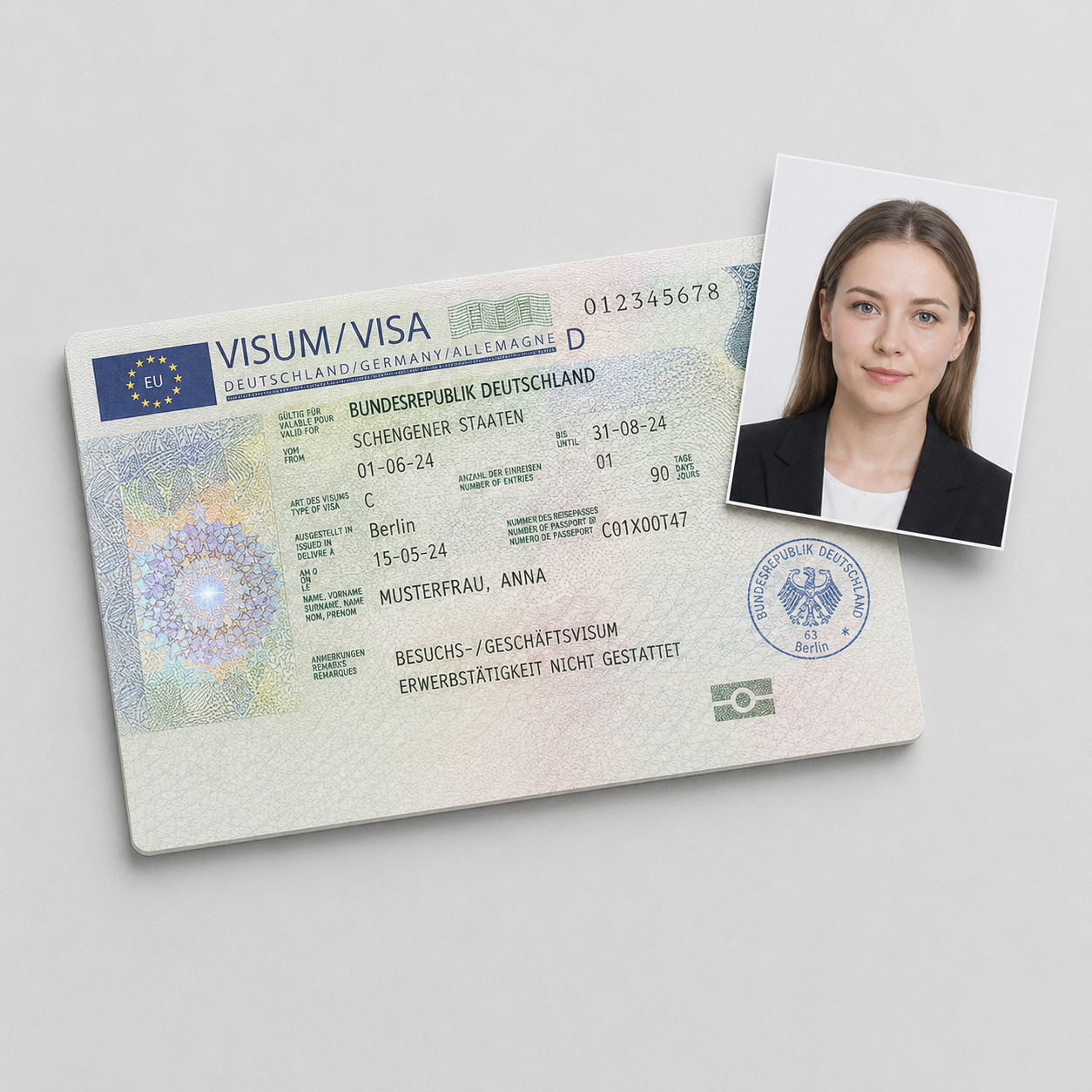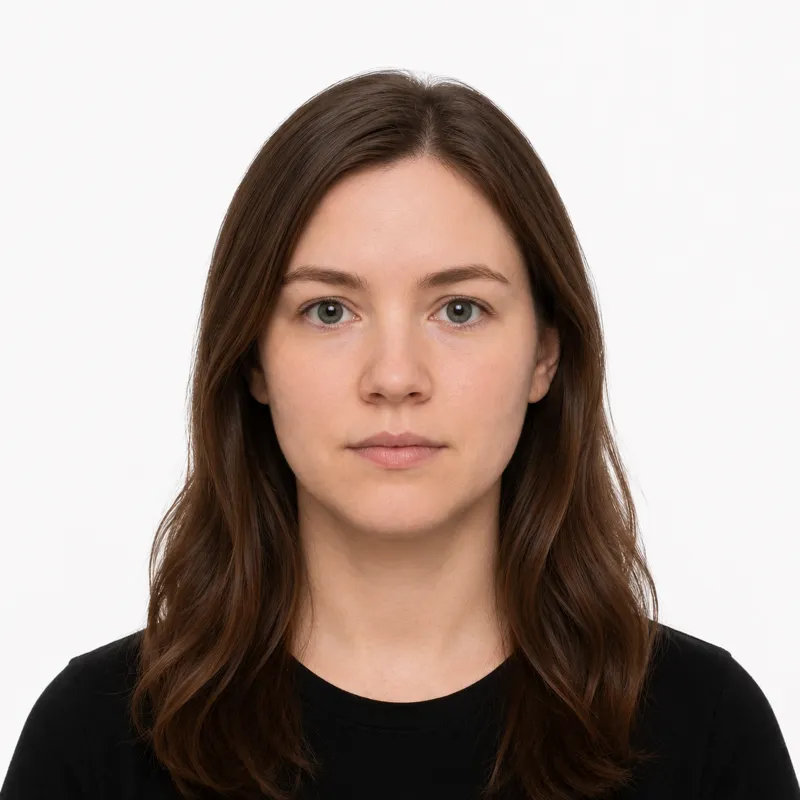
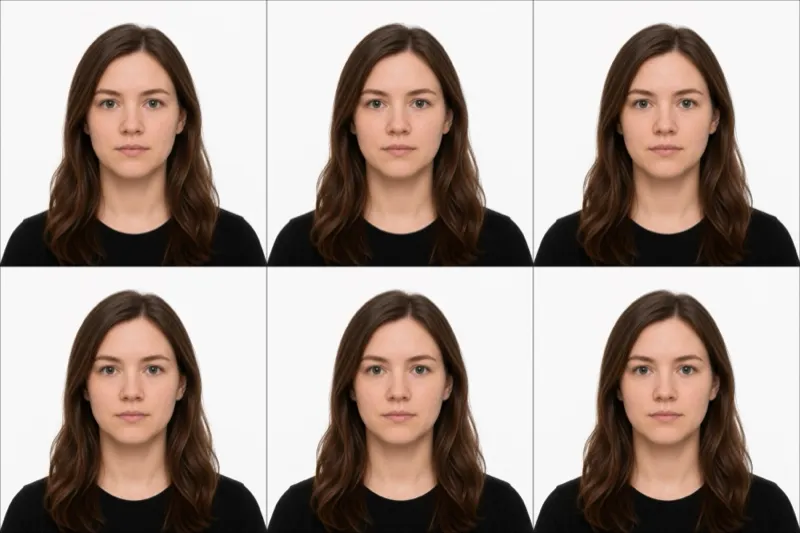
The official requirements
Since 1 May 2025 a German passport photo has to reach the Bürgeramt digitally, not as a paper print, which changes how you get one before the spec even matters. The BMI biometric standard:
- Size: 35×45 mm (width × height), portrait
- Background: plain white or light grey, uniform with no patterns or shadows
- Head size: face covers 70–80% of the photo height (about 32–36 mm chin to crown)
- Eye position: eyes between roughly 50% and 70% of the photo height from the bottom
- Expression: neutral, mouth closed, both eyes open, looking straight at the camera
- Glasses: not allowed, unless medically necessary with a doctor’s certificate
- Recency: taken within the last 6 months
- Color: color photo, even lighting, no filters
Since 1 May 2025, the photo also has to be digital and reach the office through an approved channel — printed photos you took yourself are no longer accepted (see Submitting your photo).
How to take a compliant photo
A current phone camera is sharp enough; German rejections are almost always about framing, background, and lighting. The setup that works:
- Stand 1.5–2 metres in front of a plain white or light-grey wall, with enough distance behind you that no shadow falls on the wall.
- Face a window for soft, even front light. Overhead light leaves shadows under the eyes and nose.
- Have someone else take it from chest height, straight on. Selfies distort the face shape and almost always frame the head wrong.
- Look straight at the lens, neutral mouth, both eyes open, hair clear of the eyebrows and eyes.
- Crop to 35×45 mm with the face filling 70–80% of the height — or upload the shot to a tool that measures and crops to the German biometric spec, then arrive at the Bürgeramt with a digital file.
Why photos get rejected
Bürgerämter return the same handful of problems repeatedly. Each one, and the fix:
- Wrong size — submitting the US 2×2 inch or UK 45×35 mm format. It must be 35×45 mm portrait.
- Face outside 70–80% of the frame — too small (looks like a snapshot) or too tight (head cropped). Re-crop or re-shoot from the right distance.
- Glasses left on — Germany tightened this rule in 2020. Take them off unless you have a doctor’s certificate that you cannot.
- Background not uniform — a patterned wall, a shadow, or a colour other than white/light grey gets the photo bounced.
- Smiling or showing teeth — neutral expression only. A slight closed-mouth smile is borderline; safer to keep the mouth fully neutral.
- Filtered or beautified photo — phone “beauty” filters and skin smoothing fail the biometric check.
- Photo older than 6 months — it must reflect your current appearance.
What to wear (and not wear)
Germany recommends a light-grey background, which flips the usual advice: a white shirt now blends into the backdrop rather than standing out. A darker, solid colour photographs cleaner.
Avoid: glasses of any kind, hats or caps, hoods, headphones, uniforms, and a white top against the light-grey background.
Fine: ordinary everyday clothing, light makeup that doesn’t change your everyday look, religious head coverings worn daily (face fully visible from forehead to chin), and medical devices like hearing aids.
Glasses are the most common surprise: many applicants don’t know Germany aligned with the EU ban in 2020, and even prescription glasses are turned away without a medical certificate.
Where to get your photo
Since the May 2025 rule, the question isn’t just price — it’s how the photo reaches the Bürgeramt. Real options in Germany:
| Where | Price (EUR) | Appointment | Speed | Reaches the Bürgeramt as |
|---|---|---|---|---|
| Fotograf (photo studio) | €15–€25 | Often yes | Same day | QR / data-matrix code from a certified studio |
| PointID / similar terminal at the Bürgeramt | €6 | No — taken at your appointment | Minutes | Direct upload from the terminal |
| Fotoautomat (street/station booth, biometric mode) | €8–€12 | No | Minutes | QR code, only if the booth is certified for the BSI cloud |
| dm / Rossmann photo counter | €10–€15 | No | Same day | QR code, only at branches with a certified terminal |
| Online tool (this site) | ~€1 | No | ~2 minutes | Print yourself — accepted by some consulates abroad; not accepted at a German Bürgeramt under the May 2025 rule |
Inside Germany, the simplest path is the €6 terminal at your appointment or a certified studio that hands you a QR code. Older Fotoautomaten and online tools still produce a perfectly compliant image — useful for German consulate applications abroad, schools, employer files, or visa packets that accept printed photos — but a Berlin or Hamburg Bürgeramt will not accept a printed photo you brought in yourself.
Submitting your photo
The May 2025 rule split Germany from its own consulates: digital-only inside the country, still paper at most missions abroad.
At a Bürgeramt in Germany — Since 1 May 2025 the photo must arrive digitally. Two routes are accepted: (1) take the photo at the Bürgeramt’s own terminal at your appointment, or (2) bring a QR / data-matrix code from a certified photo studio, which the clerk scans to pull the image from the BSI-certified cloud. A short transition period in mid-2025 allowed paper photos in exceptional cases; that window has closed. Plan for the digital channel.
At a German embassy or consulate abroad — Most missions still ask for two identical printed 35×45 mm biometric photos with the application. The German Missions in the US, for example, list printed photos as a required document. Check your specific consulate’s page before printing — a small number have begun moving to digital intake too.
If you’re applying inside Germany, do not print a photo at home and bring it; it will be refused. If you’re applying abroad, print on photo paper and bring two identical copies.
Babies, kids & special situations
Infants and toddlers follow the same biometric rules — plain background, neutral expression, no hands, arms, toys, or pacifiers in the frame. For very young babies, lay the child on a white sheet and shoot from directly above; both eyes should be open and visible. Bürgerämter generally recommend using a certified studio for children under six rather than the on-site terminal.
Religious head coverings are permitted when worn daily for religious reasons. The face must be fully visible from the lower forehead to the chin, with no shadows cast by the covering.
Glasses are not permitted, including prescription glasses. The only exception is a documented medical reason — recovering from eye surgery, for example — supported by a doctor’s certificate.
Medical devices such as hearing aids or oxygen tubes worn daily are allowed and do not need to be removed.
Ready to skip the studio?
Upload a selfie and get a compliant photo in 2 minutes.
Sources & References
This guide is fact-checked against official government publications and updated regularly to reflect the latest requirements.
- [1]
- [2]
- [3] German Missions in the US — Passport for adultsgermany.info