Schengen Visa Photo Requirements: Size, Rules & Country Guide
Official Schengen visa photo requirements for 2026: 35x45mm size, ICAO standards, country-by-country rules, and how to get compliant photos in the US.
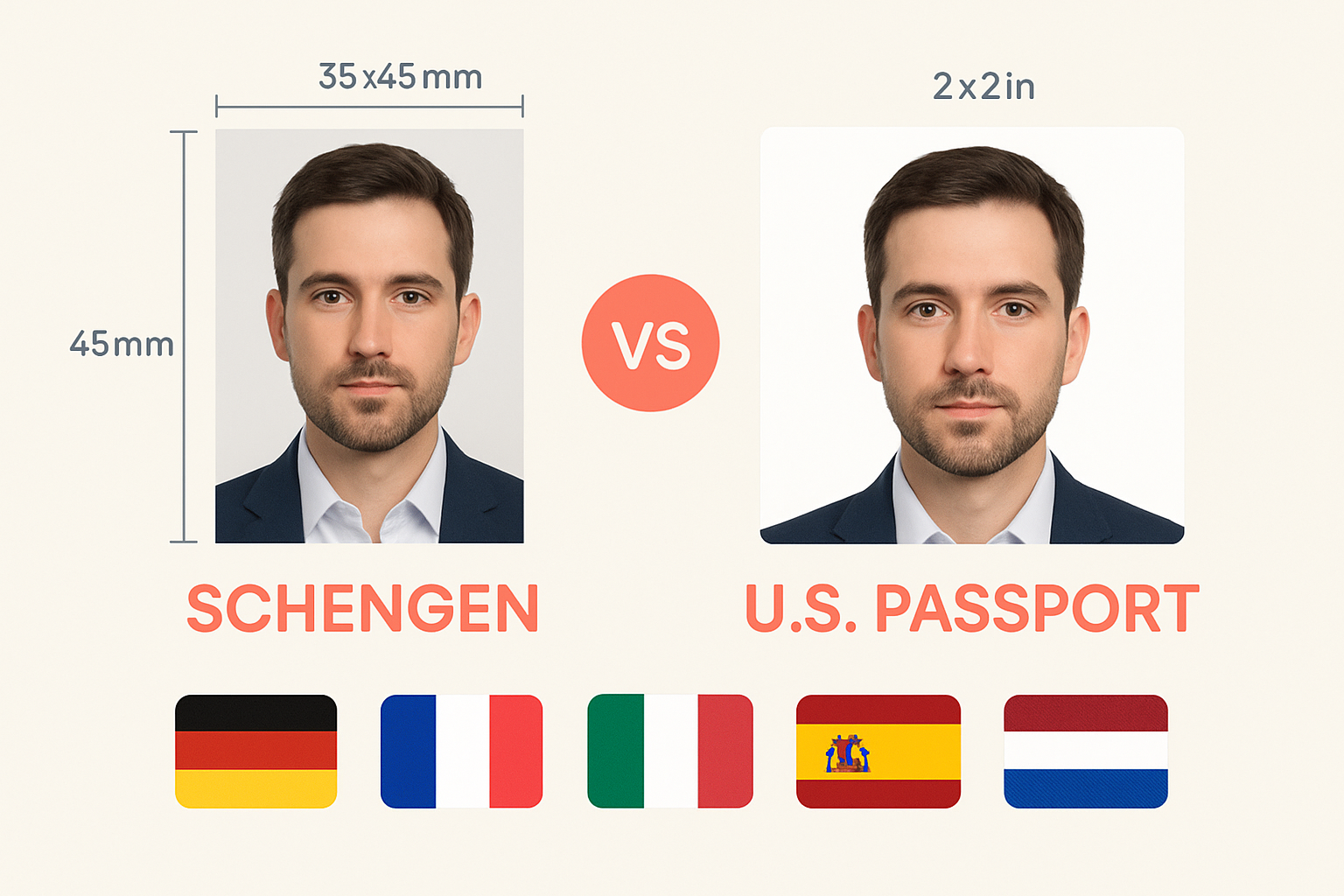
Planning a trip to Europe? If you need a Schengen visa, your photo is one of the first things the consulate checks — and one of the most common reasons applications get kicked back. Schengen visa photos follow strict European biometric standards with specific size and formatting requirements.
Here’s everything you need to know about Schengen visa photo requirements, country-by-country variations, and how to get properly sized photos without leaving your house.
Standard Schengen Visa Photo Specifications
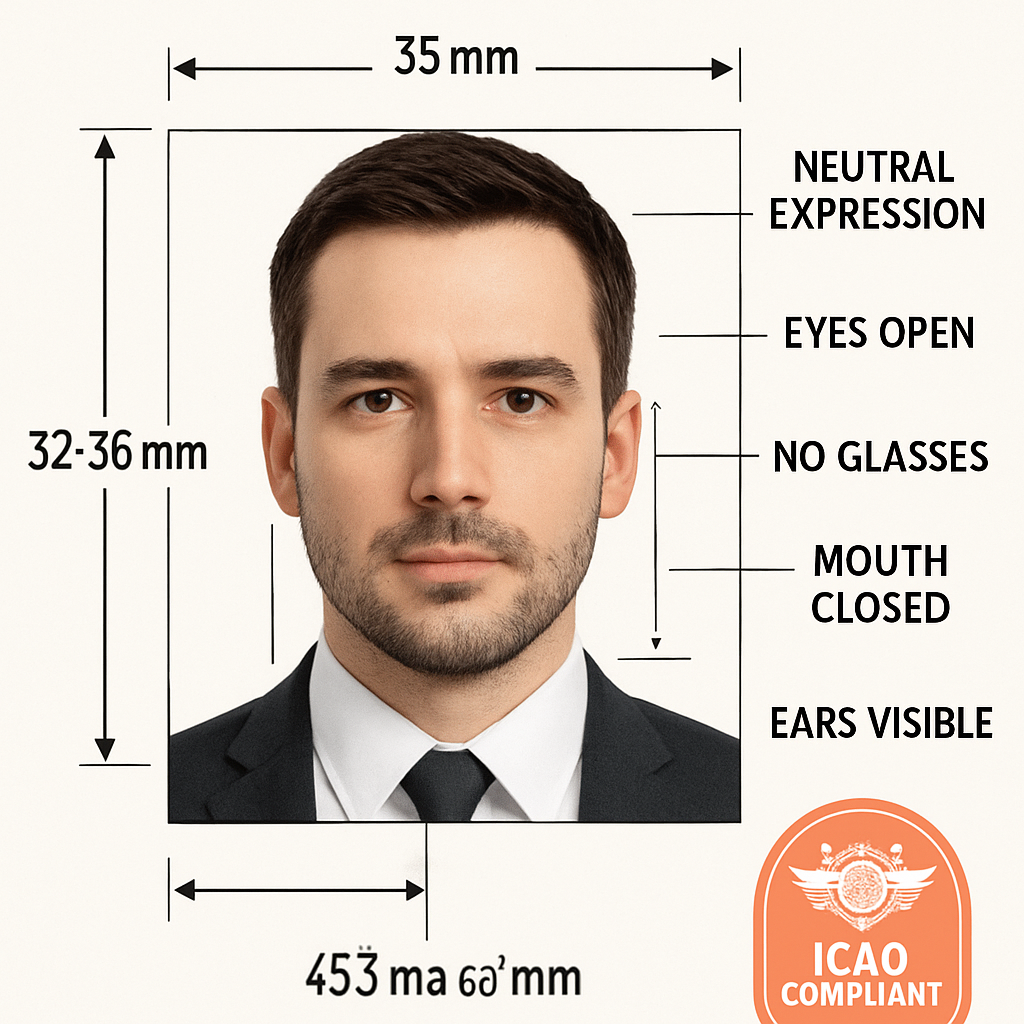
All 29 Schengen member states follow the same baseline photo requirements, governed by the EU Visa Code (Regulation EC 810/2009) and ICAO (International Civil Aviation Organization) standards:
| Requirement | Specification |
|---|---|
| Quantity | 2 identical photos |
| Print size | 35 × 45 mm (1.38 × 1.77 inches) |
| Face height | 32–36 mm from chin to crown of head |
| Face coverage | 70–80% of the photo frame |
| Background | Plain light color — light gray preferred |
| Color | Full color (no black-and-white) |
| Recency | Taken within the last 6 months |
| Expression | Neutral, mouth closed, both eyes open |
| Glasses | Allowed only if eyes are fully visible (no tinted lenses, no frame obstruction) |
| Head covering | Not allowed unless worn daily for religious reasons |
| Print quality | Photo paper, minimum 600 DPI resolution |
| Focus | Sharp, high contrast, no shadows or reflections |
That last column matters more than you’d think. Schengen consulates are strict about print quality. A photo printed on regular paper from your home inkjet printer will get rejected, even if the composition is perfect.
The key difference from a US passport photo: Schengen photos are 35×45mm — taller and narrower than the square 2×2 inch (51×51mm) US format. This means every aspect of the framing is different. You can’t crop a US passport photo into a Schengen photo and expect it to work.
Schengen vs. US Passport Photo: Side by Side
This is where Americans applying for a Schengen visa run into trouble. The two formats look similar at a glance but are fundamentally different:
| Schengen Visa Photo | US Passport Photo | |
|---|---|---|
| Size | 35 × 45 mm (1.38 × 1.77 in) | 51 × 51 mm (2 × 2 in) |
| Shape | Rectangular (portrait) | Square |
| Background | Light gray preferred | White or off-white |
| Face coverage | 70–80% of frame | 50–69% of frame |
| Face height | 32–36 mm | 25–35 mm (1–1⅜ in) |
| Glasses | Allowed with conditions | Not allowed at all |
| Print resolution | 600 DPI minimum | No specific DPI requirement |
Three things jump out:
- The size is totally different. Schengen is rectangular (35×45mm). US is square (51×51mm). You cannot use one for the other.
- The face fills more of the frame in a Schengen photo (70–80%) compared to a US photo (50–69%). Your face needs to be larger relative to the image.
- Schengen still technically allows glasses — as long as your eyes are fully visible with no reflections or frame obstruction. The US banned glasses entirely in 2016. That said, the safe play for Schengen applications is to remove your glasses anyway. Many consulates will flag eyeglasses regardless of the official rule.
Country-by-Country Variations
The EU Visa Code sets the baseline, but individual consulates can be stricter (never more lenient) on certain points. Here’s what to know about the most popular Schengen destinations:
Germany 🇩🇪
Germany is one of the strictest when it comes to photo compliance. German consulates follow the Federal Foreign Office biometric photo standards, which add these requirements on top of the EU baseline:
- Background: Strictly light gray (uniform, no gradient). White backgrounds are sometimes flagged.
- Face height: Must be exactly 32–36mm — they measure.
- Glasses: Strongly discouraged. While technically allowed, German consulates frequently reject photos with any eyewear.
- Shadows: Zero tolerance. Even faint shadows behind the head get flagged.
France 🇫🇷
France follows the standard EU Visa Code specs closely. A few practical notes:
- Background: Light gray or light blue both accepted at French consulates.
- Expression: Strictly neutral — even a slight smile can be rejected.
- Photo booths: France has a network of approved photo booths (photomatons) throughout the country. If you’re applying from within France, these machines produce compliant photos automatically.
Italy 🇮🇹
Italy is generally in line with the standard specs:
- Background: White or light gray accepted.
- Photo age: Italian consulates are particularly strict about the 6-month rule. If you’ve changed your hairstyle, facial hair, or hair color, they may ask for a newer photo even if it’s within 6 months.
- Print quality: High-quality photo paper required — matte or glossy both work.
Spain 🇪🇸
Spain follows EU standards closely with one notable point:
- Background: White background is preferred and most commonly accepted at Spanish consulates.
- Photo size: Strictly 35×45mm. Some applicants have reported rejections for photos that were even slightly off-size.
- Ears: Both ears should be visible if possible (hair pulled back).
Netherlands 🇳🇱
The Netherlands follows ICAO standards closely:
- Background: Light gray or white uniformly lit.
- Facial coverage: The Dutch are strict about the 70–80% face coverage requirement. If your face is too small in the frame, it’s rejected.
- Head angle: Must be perfectly straight — no tilt at all.
Greece 🇬🇷, Portugal 🇵🇹, Austria 🇦🇹
These countries follow the standard EU baseline without significant additional requirements. Stick to the official specs and you’ll be fine.
Common Rejection Reasons
Schengen consulates reject photos frequently. Here are the most common reasons, ranked by how often they cause problems:
- Wrong size. This is number one for Americans. Submitting a 2×2 inch photo instead of 35×45mm gets an immediate rejection. No exceptions.
- Background issues. Too dark, uneven lighting, shadows on the background, wrong color. Light gray is the safest bet across all Schengen countries.
- Face too small or too large. The 70–80% rule is strictly enforced. Passport photo services calibrated for US specs often get this wrong because the US only requires 50–69%.
- Shadows on the face. Even subtle shadows under the chin, nose, or around the eyes. Lighting needs to be uniform.
- Expression problems. Mouth open, smiling, squinting. Neutral means neutral.
- Photo too old. Must be within 6 months and reflect your current appearance. Changed your hair? New photo.
- Glasses glare or obstruction. If you choose to keep glasses on, any reflection or frame shadow across the eyes means rejection.
- Low print quality. Photos printed on regular paper, pixelated images, or inkjet prints on photo paper with visible dots.
Tips for Americans Applying for a Schengen Visa
If you’re a US citizen or resident applying for a Schengen visa (or helping family members apply), keep these practical points in mind:
Don’t use your US passport photo
Your 2×2 inch passport photo will not work for a Schengen application. The size is wrong. The face-to-frame ratio is wrong. Even if you tried to crop or resize it, the proportions won’t match. You need a new photo taken specifically for the 35×45mm format.
Where to get Schengen-sized photos in the US
Here’s the challenge: most US photo services — CVS, Walgreens, Costco, UPS Store — are set up for US passport photos (2×2 inches). Many of them don’t offer 35×45mm sizing at all. Your options:
- Specialty photo studios in major cities, especially near European consulates, often offer international passport photo sizes. Expect to pay $15–30.
- European consulate offices sometimes have approved photo services nearby or photo booths in the waiting area.
- Online photo tools that support multiple country formats — this is the most reliable and affordable option.
Get your photos early
Don’t wait until the day before your consulate appointment. Give yourself at least a week to get photos taken, check them against the requirements, and reprint if needed.
Print on proper photo paper
If you’re printing at home or at a drugstore kiosk, make sure you select photo-quality paper. Some kiosks default to regular paper for custom sizes — double check before you pay.
How One Dollar Passport Photo Handles Schengen Format
Most US photo services are hardcoded for 2×2 inch output. One Dollar Passport Photo supports passport and visa photo formats for countries worldwide — including the 35×45mm Schengen/EU format.
Here’s how it works:
- Select your destination country — choose any Schengen member state (Germany, France, Italy, Spain, etc.) and the tool automatically applies the correct 35×45mm dimensions, face-to-frame ratio, and background requirements.
- Upload any photo from your phone or camera — selfie, portrait, whatever you have.
- AI processes your photo — background replacement to compliant light gray/white, proper face positioning and cropping to meet the 70–80% coverage rule, correct sizing to 35×45mm.
- Download print-ready files — formatted for standard 4×6 photo paper with multiple copies, ready to print at any drugstore or photo kiosk.
No appointment. No hunting for a specialty studio that knows European photo specs. No risk of getting the wrong size.
Create Your Schengen Visa Photo Now →
One photo. One dollar. Correctly sized for every Schengen country.
The Full List of Schengen Member States
As of 2025, these 29 countries are part of the Schengen Area and require the same 35×45mm photo format for visa applications:
Austria, Belgium, Bulgaria, Croatia, Czech Republic, Denmark, Estonia, Finland, France, Germany, Greece, Hungary, Iceland, Italy, Latvia, Liechtenstein, Lithuania, Luxembourg, Malta, Netherlands, Norway, Poland, Portugal, Romania, Slovakia, Slovenia, Spain, Sweden, and Switzerland.
Note: Iceland, Liechtenstein, Norway, and Switzerland are Schengen members but not EU members. They follow the same visa photo requirements regardless.
Frequently Asked Questions
Can I use my US passport photo for a Schengen visa application?
No. US passport photos are 2×2 inches (51×51mm, square). Schengen visa photos must be 35×45mm (rectangular). The size, shape, and face-to-frame ratio are all different. You need a new photo specifically formatted for the Schengen standard.
Are Schengen visa photo requirements the same for every country?
The baseline requirements are identical across all 29 Schengen member states — 35×45mm, ICAO compliant, light background, neutral expression. However, individual consulates may be stricter on specific details. Germany is particularly strict about background color (light gray only) and shadows. France accepts light blue backgrounds. When in doubt, stick to light gray background and remove glasses.
Can I wear glasses in my Schengen visa photo?
Technically, yes — unlike US passport photos, Schengen rules still allow prescription glasses as long as your eyes are fully visible with no reflections or frame shadows. However, many consulates (especially Germany) discourage glasses and may reject photos with them. The safe play: take your glasses off.
How recent does my Schengen visa photo need to be?
Within the last 6 months, and it must reflect your current appearance. If you’ve significantly changed your hair, grown or shaved a beard, or had any noticeable changes to your appearance, take a new photo — even if the old one is less than 6 months old.
What background color should I use?
Light gray is the safest choice and is preferred by most Schengen consulates, especially Germany and the Netherlands. White is generally accepted by Italy, Spain, and others. France also accepts light blue. Avoid pure white if you’re applying at a German consulate — they may flag it as too bright.
Can I take my Schengen visa photo with my phone?
Yes — but you need proper lighting, a plain background, and a way to produce the correct 35×45mm output. A phone camera gives you sufficient resolution, but you’ll still need to format the photo correctly. Use One Dollar Passport Photo to handle the sizing, background, and formatting automatically from any phone photo.
Where can I print 35×45mm photos in the US?
Most US drugstores don’t offer 35×45mm as a standard option. Your best bet is to use a service like One Dollar Passport Photo that generates a print-ready template on standard 4×6 photo paper — then print at any CVS, Walgreens, or photo kiosk for under $1. Alternatively, specialty photo studios near European consulates in major cities typically offer international sizes.
How many photos do I need for a Schengen visa application?
Two identical photos per application. If you’re applying for multiple family members, each person needs their own set of two photos. It’s smart to print extras — bring four just in case the consulate needs additional copies.
Ready to create your passport photo?
Get a compliant photo in 2 minutes for just $1. No signup required.