Chinese Visa Photo Requirements: Size, Background & Digital Specs (2026)
Complete guide to Chinese visa photo requirements in 2026. Learn the exact size (33×48mm), white background rules, digital specs, and how to avoid CVASC rejections.
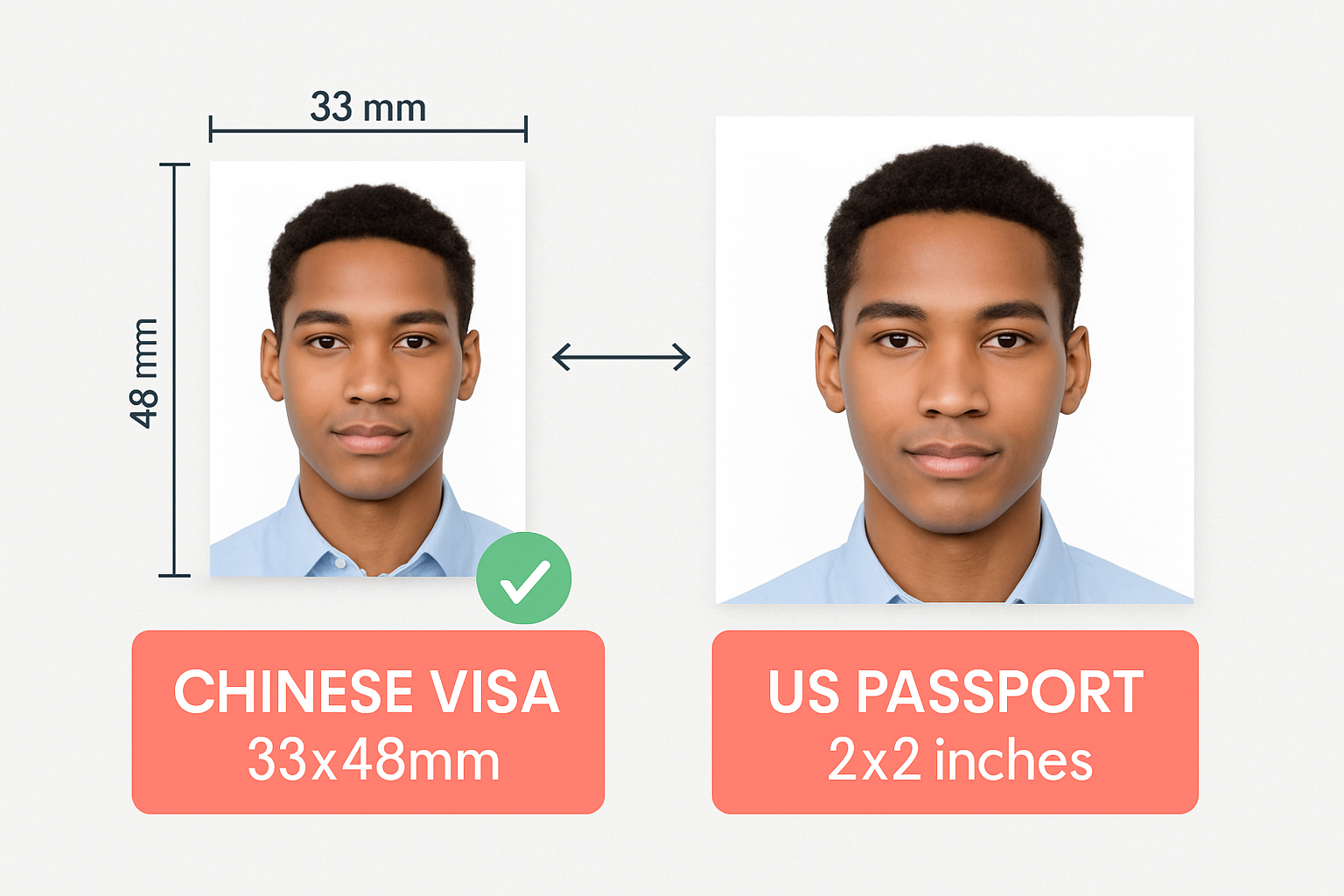
Chinese visa photos follow completely different rules than US passport photos. Different size, different dimensions, different digital specs. Use a US passport photo for your China visa application and it gets rejected on the spot.
The core difference: Chinese visa photos are 33 × 48mm — taller and narrower than the square 2 × 2 inch (51 × 51mm) US standard. That single dimension change trips up more applicants than any other requirement.
Here’s every specification you need to get it right the first time, whether you’re applying for a tourist (L), business (M), student (X), or work (Z) visa.
Chinese Visa Photo Specifications
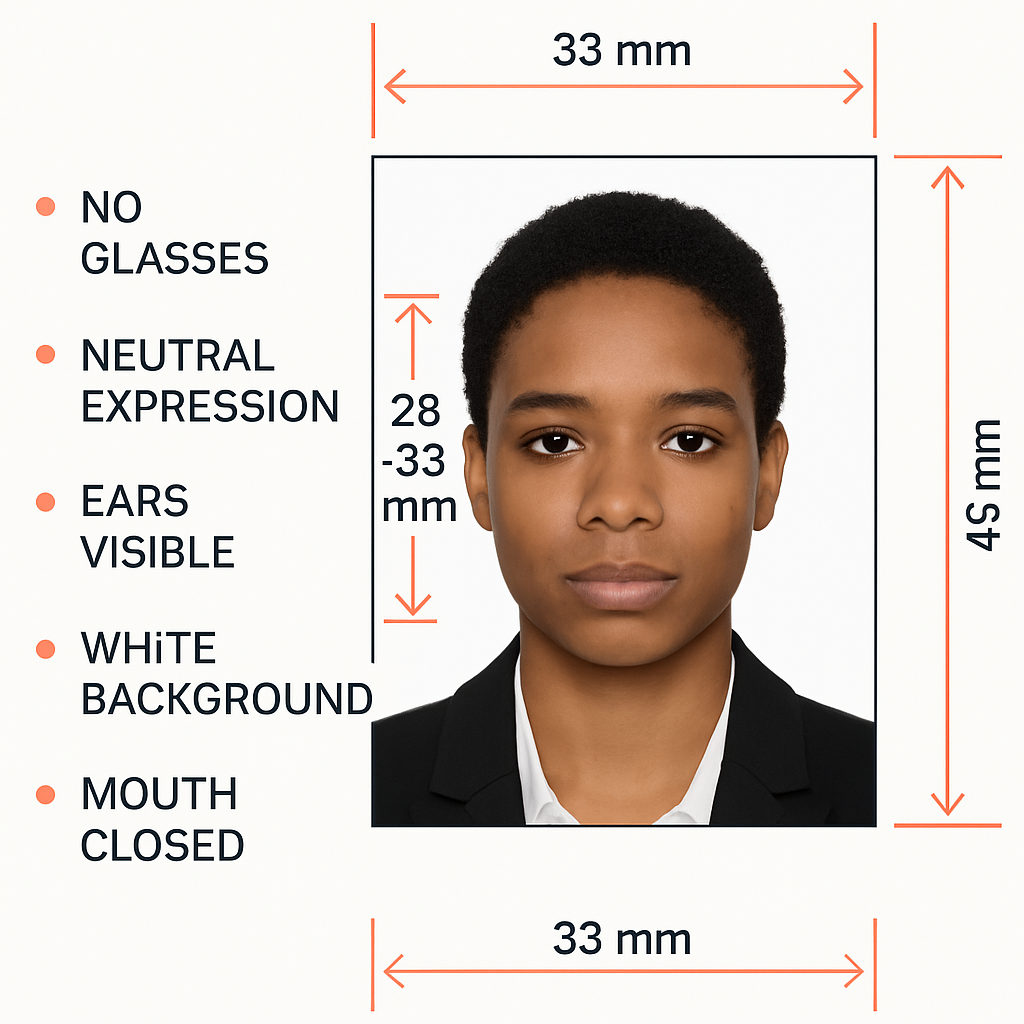
These requirements apply to all Chinese visa categories — tourist, business, student, work, family reunion, and transit:
| Requirement | Specification |
|---|---|
| Print size | 33 × 48 mm (1.3 × 1.9 inches) |
| Head height | 28–33 mm, from chin to crown |
| Face width | 15–22 mm |
| Background | Plain white — no patterns, no gradients |
| Color | Full color (no black-and-white) |
| Recency | Taken within the last 6 months |
| Expression | Neutral, mouth closed, both eyes open |
| Glasses | Not allowed |
| Ears | Both ears must be visible |
| Quantity | 1 photo glued to application form + 1 spare |
| Paper | Photo-quality paper, matte or glossy |
That head height range (28–33mm) is tighter than most countries require. Your head needs to fill roughly 58–69% of the photo height. Too small and CVASC flags it. Too large and you’re cropping into the chin or crown.
The white background is non-negotiable. Not off-white. Not light gray. Not cream. Pure white. CVASC (Chinese Visa Application Service Center) staff check this carefully, and they use photo scanning equipment that detects even subtle background tinting.
Digital Photo Requirements for Online Applications
If you’re applying through the CVASC online portal or the Chinese visa online application form (Form V.2013), you’ll need to upload a digital photo. The digital specs differ from the US standard:
| Requirement | Specification |
|---|---|
| File format | JPEG (.jpg) |
| Pixel dimensions | 354 × 472 pixels |
| Aspect ratio | 3:4 (width:height) |
| File size | 40 KB – 120 KB |
| Color depth | 24-bit color |
| Resolution | 300 DPI equivalent |
| Background | White (RGB 255,255,255 or near-white) |
Pay attention to that file size range: 40–120 KB. That’s a narrow window. Most smartphone cameras produce images in the megabyte range, and even compressed JPEGs often land above 120 KB. You’ll need to resize and compress specifically for this requirement.
The pixel dimensions (354 × 472) map directly to the physical 33 × 48mm size at 300 DPI. That’s the math: 33mm ÷ 25.4 × 300 = ~390 pixels (they round to 354), 48mm ÷ 25.4 × 300 = ~567 pixels (they round to 472). These aren’t arbitrary numbers — the system validates them.
Pro tip: The CVASC online system will reject photos that don’t fall within these exact specs. There’s no “close enough.” If your file is 121 KB, it fails. If your image is 355 × 472 pixels, it may fail. Hit the exact numbers.
Chinese Visa Photo vs. US Passport Photo
This is where most US-based applicants run into trouble. You’ve got a perfectly good passport photo — why can’t you use it for China?
| Chinese Visa Photo | US Passport Photo | |
|---|---|---|
| Print size | 33 × 48 mm | 51 × 51 mm (2 × 2 in) |
| Aspect ratio | 3:4 (portrait) | 1:1 (square) |
| Digital size | 354 × 472 px | 600 × 600 px |
| Digital file size | 40–120 KB | ≤ 240 KB |
| Background | White only | White or off-white |
| Head height | 28–33 mm | 25–35 mm |
| Ears visible | Required | Not required |
| Glasses | Not allowed | Not allowed |
| Expression | Neutral, mouth closed | Neutral |
The key differences:
- Size and shape. Chinese visa photos are rectangular (3:4 portrait), not square. You can’t just crop a US passport photo — the proportions are fundamentally different.
- Stricter background. The US accepts “white or off-white.” China requires pure white. That off-white wall you stood in front of? May pass for a US passport but will fail for a Chinese visa.
- Ears must be visible. Hair covering your ears is specifically flagged in Chinese visa applications. The US has no such requirement.
- Tighter file size. 40–120 KB vs. up to 240 KB. The Chinese system is far more restrictive on digital uploads.
Bottom line: You need a separate photo for your Chinese visa application. Don’t try to repurpose your US passport photo.
Photo Requirements by Visa Type
Good news — the photo specs are identical across all Chinese visa categories. Whether you’re applying for:
- L visa (Tourist) — sightseeing, visiting friends
- M visa (Business) — commercial activities, trade fairs
- X1/X2 visa (Student) — study programs over/under 180 days
- Z visa (Work) — employment in China
- Q1/Q2 visa (Family Reunion) — visiting Chinese relatives
- F visa (Non-commercial visit) — exchanges, research
- S1/S2 visa (Private affairs) — accompanying family members
- C visa (Crew) — airline/ship crew members
…the photo requirements are the same 33 × 48mm, white background, all the specs in the table above. The visa type determines your supporting documents, processing time, and fees — not your photo specifications.
The only exception is the diplomatic (D) visa, which may have additional security photo requirements handled directly through the Chinese embassy.
How CVASC Checks Your Photos
CVASC (Chinese Visa Application Service Center) is the front line for visa processing in most countries. They’re the ones who physically inspect your application before it goes to the Chinese embassy or consulate.
Here’s what happens to your photo at CVASC:
- Visual inspection. A CVASC staff member checks your printed photo against requirements — size, background, expression, ear visibility, head position.
- Measurement check. They may use a template or ruler to verify the 33 × 48mm dimensions and head size within the photo.
- Digital scan. If you submitted digitally, the system automatically validates pixel dimensions, file size, and aspect ratio. Out-of-spec photos are rejected before a human even sees them.
- Background analysis. The scanning system checks for pure white backgrounds. Subtle color casts (common from phone photos taken indoors) get flagged.
If your photo fails at CVASC, you have two options: fix it on the spot (some CVASC locations have photo booths, typically for $10–20) or leave and come back with corrected photos. Either way, you’re losing time.
Some CVASC locations in major cities (New York, Los Angeles, San Francisco, Chicago, Houston) have in-house photo services, but they charge premium prices and the lines can be significant during peak season.
Common Rejection Reasons
CVASC staff and automated systems flag these issues most frequently:
Size and Dimension Errors
- Wrong photo size. Using 2 × 2 inch (US standard) instead of 33 × 48mm. This is the #1 rejection reason for US-based applicants.
- Head too small or too large. Must be 28–33mm from chin to crown. Head filling less than 58% or more than 69% of the image height fails.
- Incorrect digital dimensions. Anything other than 354 × 472 pixels for online submissions.
Background Issues
- Not pure white. Off-white, gray, light blue, cream — all rejected. Even slight yellowish tinting from indoor lighting gets flagged.
- Shadows on background. Any visible shadows behind you, no matter how faint.
- Uneven lighting. One side of the background brighter than the other.
Face and Appearance
- Ears not visible. Hair must be tucked behind both ears. This catches many applicants by surprise.
- Glasses of any kind. Prescription, sunglasses, reading glasses, fashion frames — none allowed.
- Mouth open. Even slightly parted lips can trigger rejection.
- Eyes not fully open. Both eyes must be clearly visible and open.
- Head tilted. Must be straight-on, no angle.
Technical Issues
- Digital file too large or small. Must be 40–120 KB. This narrow range catches most people.
- Wrong file format. Must be JPEG. PNG, HEIC, PDF — all rejected.
- Low resolution. Blurry or pixelated photos from heavy compression.
- Digital editing detected. Beauty filters, skin smoothing, background replacement via obvious editing. Subtle AI background removal to white is generally fine — aggressive retouching is not.
How to Take a Chinese Visa Photo at Home
You don’t need a photo studio. Here’s the process:
- Find a white wall. Not off-white, not beige — white. A white poster board or sheet works too.
- Lighting. Face a window for even natural light. Avoid overhead-only lighting (creates shadows under your eyes and on the background).
- Camera. Any modern smartphone works. Use the rear camera (higher quality) with a timer or have someone take it.
- Position. Stand 1–2 feet from the wall. Face directly at the camera. Tuck hair behind both ears. Neutral expression, mouth closed.
- Distance. The photographer should be about 4–5 feet away. Don’t use a selfie — the wide-angle lens distorts your face.
- Crop and format. This is where most DIY attempts fail. You need to crop to exactly 33 × 48mm proportions, set the head size to 28–33mm, compress to 40–120 KB, and export at 354 × 472 pixels.
That last step is where One Dollar Passport Photo saves you the headache.
The Easy Way to Get Chinese Visa Photos
Getting the right photo size, background, and digital specs for a Chinese visa is harder than for most countries. The unusual dimensions, strict file size window, and ear visibility requirements create multiple failure points.
One Dollar Passport Photo handles all of this automatically:
- Select “China” as your country and “Visa” as the document type on the photo selection page
- Upload any photo — selfie, portrait, whatever you have
- AI processes everything — crops to 33 × 48mm proportions, removes background to pure white, positions your head to 28–33mm, adjusts for ear visibility
- Download your photo — both the digital version (354 × 472 px, 40–120 KB JPEG) for online applications and a print-ready template for physical submissions
No figuring out pixel dimensions. No wrestling with file compression. No driving to a photo studio that may or may not know Chinese visa specs.
Create Your Chinese Visa Photo Now →
One photo. One dollar. Correct specs guaranteed.
Tips for a Smooth CVASC Visit
Beyond the photo, here’s what helps your CVASC appointment go smoothly:
- Bring extra photos. The requirement says 1 glued + 1 spare. Bring 3–4 copies. If anything goes wrong with gluing or if they need replacements, you’re covered.
- Don’t glue the photo at home. Some CVASC locations prefer to glue the photo themselves. Bring the photo loose and a glue stick — let them tell you how they want it.
- Print on photo paper. Regular printer paper doesn’t cut it. Use glossy or matte photo paper, or order prints from a photo lab.
- Check recent requirement updates. Chinese visa requirements change more frequently than US passport rules. Verify current specs on the CVASC website for your jurisdiction before your appointment.
- Book early. CVASC appointments during Chinese New Year season, summer travel season, and before major holidays fill up weeks in advance.
Frequently Asked Questions
Can I use my US passport photo for a Chinese visa?
No. Chinese visa photos are 33 × 48mm (portrait orientation), while US passport photos are 51 × 51mm (square). The dimensions, aspect ratio, and head size requirements are fundamentally different. You need a separate photo taken to Chinese specifications. Use One Dollar Passport Photo and select China as the country to get the correct format instantly.
Do I need to show my ears in a Chinese visa photo?
Yes — both ears must be visible. This is a strict requirement that doesn’t exist for US passport photos. If you have long hair, tuck it behind your ears. Hair partially covering an ear is grounds for rejection at CVASC.
What’s the digital file size limit for online Chinese visa applications?
The digital photo must be between 40 KB and 120 KB in JPEG format, with dimensions of exactly 354 × 472 pixels. This is a much tighter range than the US passport photo standard (up to 240 KB, 600 × 600 px). Most phones produce images far larger than 120 KB, so you’ll need to resize and compress.
Is the photo the same for tourist, business, and student visas?
Yes. All Chinese visa categories (L, M, X, Z, Q, F, S, C, R) require the same photo specifications: 33 × 48mm, white background, 28–33mm head height, ears visible, no glasses. The visa type affects your supporting documents, not your photo.
Can I wear glasses in my Chinese visa photo?
No. Glasses of any kind — prescription, reading, sunglasses, or fashion frames — are not allowed. This matches the US passport photo rule that’s been in effect since 2016.
How recent does my Chinese visa photo need to be?
Your photo must be taken within the last 6 months and must reflect your current appearance. If you’ve significantly changed your look — new hairstyle, major weight change, facial surgery — take a fresh photo even if your last one is less than 6 months old.
Can CVASC take my photo on-site?
Some CVASC locations in major cities offer photo services on-site, typically for $10–20. However, availability varies by location and they may have long wait times during peak periods. Taking your photo beforehand is far more reliable — and with One Dollar Passport Photo, far cheaper.
What if my Chinese visa photo gets rejected at CVASC?
You’ll need to either use the on-site photo service (if available) or leave and return with corrected photos. Your appointment slot is lost either way. This is why getting the photo right the first time matters — save yourself the extra trip by using a tool that guarantees the correct Chinese visa specs.
Ready to create your passport photo?
Get a compliant photo in 2 minutes for just $1. No signup required.